


Picking the right doodle breed for your family is defined by one decision: matching the dog’s size, energy level, grooming needs, and temperament to your actual daily life. Doodle breeds are Poodle hybrids, combining the Poodle’s low-shedding coat and high intelligence with the personality traits of a second breed, such as a Golden Retriever, Bernese Mountain Dog, or Cocker Spaniel. The result is a wide range of dogs that look similar in photos but behave very differently in a home. Choosing based on appearance rather than lifestyle compatibility is the most common mistake Canadian families make. Getting this decision right from the start sets the foundation for years of successful companionship.
What factors should families consider first when picking the right doodle breed?
Size, energy, grooming, and temperament are the four factors that determine whether a doodle breed fits your family. Each one has real, daily consequences.
Size categories matter more than most families expect. Mini doodles typically weigh 15–35 pounds and suit apartments or smaller homes. Medium doodles land around 35–50 pounds and adapt well to most Canadian households. Standard doodles can reach 65–80 pounds and need more physical space, both indoors and outdoors. A Standard Goldendoodle in a condo with no yard is a recipe for frustration on both sides.

Energy levels vary dramatically across breeds. High-energy breeds like Aussiedoodles and Standard Labradoodles require 60–120 minutes of exercise daily. Lower-energy options like Cavapoos and Mini Bernedoodles need only 30–45 minutes. That gap is the difference between a dog that thrives on your lifestyle and one that destroys your furniture.
Grooming is a non-negotiable commitment. All doodle breeds need professional grooming every 4–8 weeks, plus 2–4 brushing sessions per week at home. No doodle is 100% hypoallergenic, though F1b and multigenerational coats shed significantly less. Budget for grooming before you budget for food.
- Size: Mini (15–35 lbs), Medium (35–50 lbs), Standard (65–80 lbs)
- Exercise: 30–45 minutes daily for calmer breeds; 60–120 minutes for high-drive breeds
- Grooming: Professional appointment every 4–8 weeks, home brushing 2–4 times weekly
- Temperament: Ranges from easygoing and gentle to intense and highly driven
Pro Tip: Ask yourself what your Tuesday looks like, not your Saturday. Your dog lives in your average week, not your best one.
How does your family’s lifestyle align with a doodle breed?
Lifestyle alignment is the step most families skip. They fall in love with a breed online and then try to fit their life around the dog. The process works better in reverse.
- Assess your activity level honestly. A family that walks 20 minutes a day is not a good match for an Aussiedoodle. A family that hikes on weekends and runs in the mornings will thrive with a Standard Goldendoodle or Labradoodle.
- Consider your children’s ages. Toddlers and very young children do best with calm, gentle breeds like Mini Bernedoodles or Cavapoos. Older kids who can participate in exercise and training open up more breed options.
- Evaluate your home and yard. A fenced yard is a major advantage for medium and standard doodles. Without one, you need a firm commitment to structured daily walks and off-leash time at a dog park.
- Be realistic about your schedule. Doodles commonly develop separation anxiety when left alone for 8 or more hours daily. If both adults work full-time, factor in the cost of a dog walker or daycare from day one.
- Set a grooming budget. Annual grooming costs for doodle breeds frequently exceed food costs over the dog’s lifetime. This is not optional spending. It is a core ownership cost.
Pro Tip: Write down your weekly schedule and mark every hour you can realistically dedicate to the dog. Then compare that number to the breed’s actual needs before you commit.
Which doodle breeds are best suited for families?
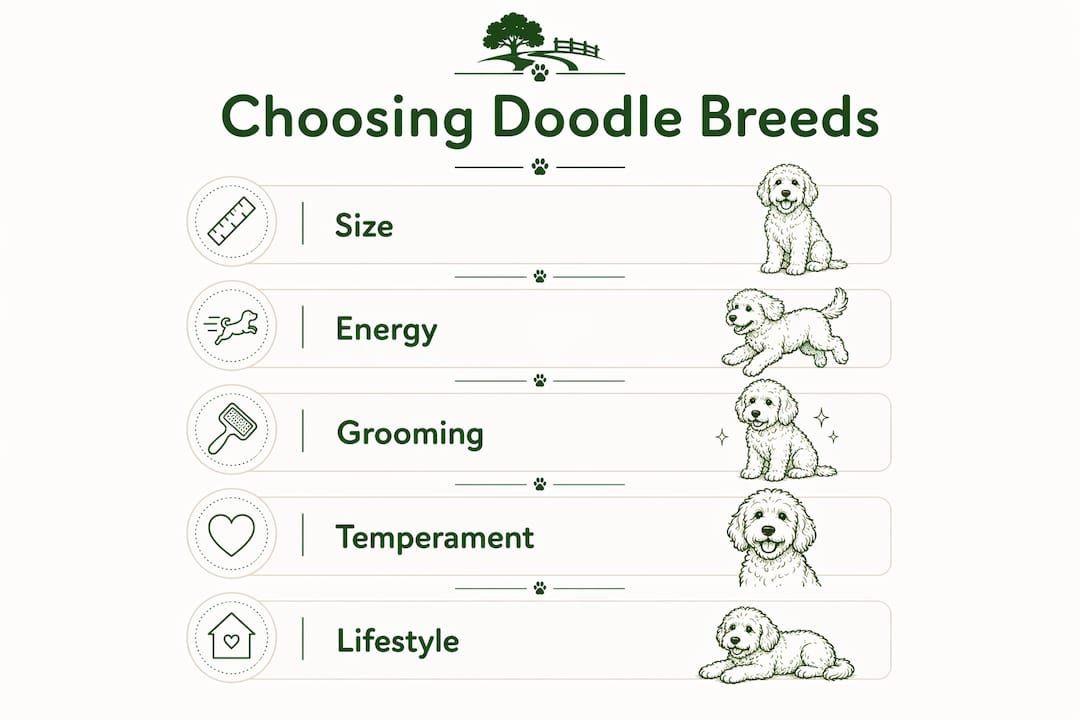
The most popular family doodle breeds each have a distinct profile. Understanding those differences makes the choice much clearer.
| Breed | Typical Size | Energy Level | Best For |
|---|---|---|---|
| Goldendoodle | Medium to Standard | Moderate to High | First-time owners, active families |
| Bernedoodle | Mini to Standard | Low to Moderate | Families with young children, calmer households |
| Cockapoo | Mini to Small Medium | Moderate | Apartment living, seniors, smaller families |
| Labradoodle | Medium to Standard | High | Athletic families, experienced owners |
| Aussiedoodle | Medium | Very High | Highly active families, experienced owners |
| Cavapoo | Mini | Low to Moderate | Gentle households, families with toddlers |
Goldendoodles and Bernedoodles are widely recognized as the most beginner-friendly doodle breeds because of their forgiving, adaptable temperaments. Aussiedoodles are high-intensity dogs that require experienced handling. They are not a good fit for first-time dog owners, regardless of how appealing they look in photos.
Lakewoodranchdoodles breeds Goldendoodles, Bernedoodles, and Cockapoos, which covers the three most family-friendly categories on this list. Each breed in their program is raised with service-animal-quality socialization from birth.
A few breed-specific notes worth knowing:
- Cavapoos carry a higher risk of heart conditions inherited from the Cavalier King Charles Spaniel side. OFA heart clearances are non-negotiable for this breed.
- Bernedoodles tend to be the most laid-back of the larger doodles, making them excellent with young children.
- Goldendoodles are highly trainable and respond well to positive reinforcement, which makes them ideal for families new to dog ownership.
How do you choose a responsible doodle breeder?
The breeder you choose shapes your dog’s health and temperament more than any other single factor. A well-bred puppy from a responsible program arrives with a head start. A poorly bred puppy can cost thousands in vet bills and years of behavioral challenges.
Responsible breeders provide written health guarantees and actively screen buyers to confirm a good lifestyle match. They ask you questions. A breeder who approves every applicant without asking about your home, schedule, or experience is not vetting for fit.
“Breeders who skip health testing and cite ‘hybrid vigor’ as their justification are using a myth as a shield. Hybrid vigor does not eliminate inherited genetic diseases. OFA hip clearances, eye certifications, and cardiac testing are required for responsible doodle breeding, regardless of generation.”
Red flags to watch for when evaluating any breeder:
- No health testing documentation available for the parents
- Refusal to allow in-person or virtual visits before purchase
- Pressure to decide quickly or pay a deposit before answering your questions
- No socialization program described for the puppies
- Inability to explain the genetic background of the litter
Genetic testing for the furnishings allele provides a more precise prediction of low-shedding coats than generational labels alone. Ask any breeder you consider whether they test for this. Understanding F1 vs. F1b coat differences helps you set realistic expectations for shedding and grooming before the puppy comes home.
Lifestyle mismatch between owner and dog is the most common reason doodle placements fail. A breeder who asks the right questions and matches puppies to families by temperament and energy level prevents that outcome.
What does ongoing doodle ownership actually require?
Bringing a doodle home is the beginning of a long-term commitment that covers grooming, training, and health care. Setting realistic expectations before the puppy arrives prevents most of the frustration families experience in the first year.
Grooming is the most underestimated cost. Professional grooming every 4–8 weeks is not optional for doodle coats. Skipping appointments leads to matting, which requires shaving the coat down completely. Home brushing 2–4 times per week keeps the coat manageable between appointments.
Training should start the week the puppy arrives. Doodles are highly intelligent, which means they learn good habits quickly and bad habits just as fast. Working with a professional trainer early prevents common issues like jumping, pulling on leash, and resource guarding from becoming ingrained behaviors.
Health care for doodles includes routine veterinary visits plus awareness of breed-specific risks. Hip dysplasia, eye conditions, and cardiac issues appear across multiple doodle lines. Choosing a breeder who completes OFA testing on both parents significantly reduces these risks.
- Schedule professional grooming every 4–8 weeks from puppyhood
- Brush at home 2–4 times per week to prevent matting
- Start training in the first week with positive reinforcement methods
- Book a veterinary wellness exam within the first 48 hours of bringing the puppy home
- Plan for separation anxiety prevention with gradual alone-time conditioning
Pro Tip: Crate training from day one is the single most effective tool for preventing separation anxiety. A crate is not a punishment. It is a safe space your dog learns to love.
Key Takeaways
Matching your family’s lifestyle to a doodle breed’s energy, size, and grooming needs is the most reliable way to avoid mismatched expectations and ensure a lasting, successful companionship.
| Point | Details |
|---|---|
| Match energy levels first | Compare the breed’s daily exercise needs to your real weekly schedule, not your ideal one. |
| Budget for grooming | Professional grooming every 4–8 weeks often costs more annually than food. |
| Choose beginner-friendly breeds | Goldendoodles and Bernedoodles suit first-time owners; Aussiedoodles require experienced handling. |
| Vet your breeder carefully | Require written health guarantees, parent health testing, and the ability to visit before committing. |
| Start training immediately | Begin positive reinforcement training the first week to prevent behavioral problems from forming. |
What I’ve learned after 20 years of matching families to doodles
The families who struggle most are the ones who chose a breed for how it looks in photos. I have seen it hundreds of times. A family falls in love with an Aussiedoodle on social media, brings one home, and then calls me six months later because the dog is bouncing off the walls and the kids are overwhelmed. The dog is not the problem. The match is the problem.
What living with and breeding multiple doodle lines has taught me is that energy compatibility matters more than coat color, size, or even breed name. A calm Goldendoodle from a well-socialized litter will outperform a poorly matched “perfect breed” every single time. Temperament is shaped by genetics, early environment, and daily routine working together. Genetics alone does not guarantee a calm dog.
The other lesson I keep coming back to is this: the breeder relationship does not end at pickup. The families who thrive long-term are the ones who stay connected, ask questions, and treat their breeder as a resource. At Lakewoodranchdoodles, we have supported families through puppyhood, adolescence, and into their dog’s senior years. That partnership is what separates a good experience from a great one.
My honest advice: be brutally honest about your lifestyle before you fall in love with a breed. Then find a breeder who asks you hard questions. If a breeder never asks about your schedule, your home, or your experience level, walk away.
— Lakewood
Lakewoodranchdoodles: finding your family’s perfect match
Lakewoodranchdoodles is a licensed, multigenerational breeding program based in Lindsay, Ontario, with over 20 years of experience raising Goldendoodles, Bernedoodles, and Cockapoos for Canadian families. Every litter is raised with documented health testing, early socialization, and lifetime breeder support built into the program.
Whether you are a first-time dog owner or adding a second dog to your household, Lakewoodranchdoodles matches puppies to families by temperament, energy level, and lifestyle fit. Browse currently available puppies to see health-tested litters with full breed details. Daily visits are available by appointment in Lindsay, Ontario, and virtual visits are offered for families across Canada. Call 705 875 5195 to speak directly with the team.
FAQ
What is the most family-friendly doodle breed?
Goldendoodles and Bernedoodles are the most family-friendly doodle breeds due to their adaptable, gentle temperaments. Both are well-suited to first-time owners and households with children.
How much does doodle grooming actually cost?
Professional grooming every 4–8 weeks is required for all doodle breeds, and annual grooming costs frequently exceed food costs over the dog’s lifetime. Budget for this before you bring a puppy home.
Are doodles truly hypoallergenic?
No doodle breed is 100% hypoallergenic. F1b and multigenerational doodles shed significantly less than F1 generations, and genetic testing for the furnishings allele gives the most accurate prediction of low shedding.
How do I know if a doodle breeder is reputable?
Reputable breeders provide written health guarantees, allow visits, and ask you lifestyle questions before approving a placement. Refusal to share health testing documents or allow visits is a clear red flag.
Can doodles handle being left alone during the workday?
Doodles left alone for 8 or more hours daily are at high risk for separation anxiety. Proactive strategies like gradual alone-time conditioning, dog walkers, or daycare significantly reduce this risk when started early.