


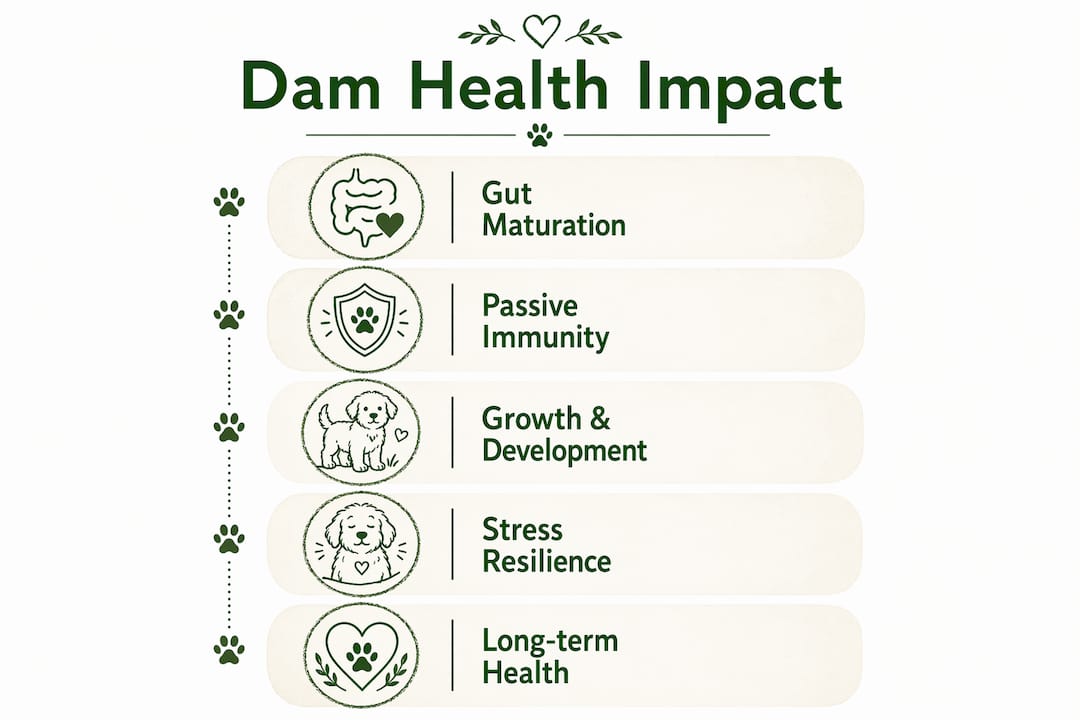
A dam’s health is the single greatest predictor of her puppies’ survival, immune strength, and long-term development. Before a puppy takes its first breath, the mother’s nutrition, microbiome, stress levels, and body condition have already shaped what that puppy will face in its first weeks of life. Breeders who understand why dam health affects puppy health gain a real advantage: lower neonatal losses, stronger litters, and puppies that thrive from day one. At Lakewoodranchdoodles, this understanding drives every decision made before, during, and after whelping.
Why dam health affects puppy health: the core mechanism
The dam is her puppies’ only source of passive immunity in the first hours of life. Colostrum, the first milk she produces, carries maternal antibodies that protect newborns from infection before their own immune systems can function. Passive immunity transfer peaks within the first 4 hours after birth, and the intestinal window for absorbing those antibodies closes completely by 16–24 hours. Miss that window, and no amount of supplementation fully replaces what was lost.
Colostrum does more than deliver antibodies. It also seeds the puppy’s gut with live bacteria that drive gut maturation and early immune system development. A dam with a healthy, diverse microbiome passes that advantage directly to her litter. Research confirms that balanced bacterial populations in the dam’s birth canal correlate with lower neonatal mortality across litters. The dam’s microbial health is not a background factor. It is a front-line puppy health factor.

Puppy immune development also depends on the antibody titers the dam achieved before breeding. A dam with current vaccinations and strong immune history produces richer colostrum. That means breeders must plan dam health well before conception, not just during pregnancy.
How does the dam transmit immunity and microbiome to her puppies?
The transfer of immunity from dam to puppy happens through two overlapping channels: antibody delivery via colostrum and microbial seeding through birth and nursing. Both channels depend entirely on the dam’s health status.
Key mechanisms breeders need to understand:
- Colostrum antibody window: Absorption closes by 16–24 hours post-birth. Every puppy must nurse within the first 4 hours for peak protection.
- Gut microbiome seeding: Colostrum delivers live bacteria that establish the puppy’s gut flora from day one. A dam with poor gut health passes a compromised microbial profile to her litter.
- Vaccination history matters: A dam’s immune history directly determines colostrum antibody quality. Up-to-date vaccinations before breeding are non-negotiable.
- Delivery method: Cesarean-born puppies initially show different oral microbiomes from vaginally delivered litters. Immediate maternal contact after a C-section helps normalize microbial profiles by 15 days of age.
- Dam microbiome as a predictor: The dam’s reproductive health history strongly predicts neonatal survival and gut health outcomes, even without formal microbiome testing.
Pro Tip: If a puppy misses the colostrum window due to a difficult birth or a weak latch, consult your veterinarian immediately about canine colostrum supplements. They are not equivalent to nursing, but they provide partial immune support.
Breeders who support dam gut health throughout the breeding cycle, rather than reacting after puppy illness appears, produce consistently stronger litters. Proactive gut health management is one of the most underused tools in responsible breeding.
What does dam nutrition do for puppy development?
A dam’s diet during gestation and lactation directly shapes her puppies’ birth weights, growth rates, and vulnerability to developmental problems. The nutrient content of her food determines the quality of her colostrum and the efficiency of nutrient transfer to her litter.
One finding that surprises many breeders: overweight dams create problems, not advantages. A 2026 study on 106 puppies found that dams with a body condition score of 6–7 out of 9 produced puppies with accelerated early weight gain and a higher incidence of swimmer syndrome. That contradicts the assumption that a heavier dam means better-fed puppies. Excess body condition in the dam disrupts normal growth regulation in the litter.
Practical nutrition guidelines for breeding dams:
- Feed a gestation-specific diet: General adult maintenance formulas do not meet the increased demands of late pregnancy and lactation. Use a diet formulated for maternal needs.
- Maintain a body condition score of 4–5 out of 9: This range supports healthy fetal development without the risks tied to excess weight.
- Supplement with Saccharomyces boulardii in late pregnancy: This yeast probiotic improves colostrum energy content and is associated with fewer low-birth-weight puppies.
- Support digestive health throughout the breeding cycle: A dam with strong gut function absorbs and transfers nutrients more efficiently. Learn more about probiotic and enzyme support for breeding dams.
Pro Tip: Weigh each puppy at birth and again at 24 hours. A puppy that gains weight in the first 24 hours has nursed successfully. One that loses more than 10% of birth weight needs immediate intervention.
Understanding nutrition’s role in puppy development starts with the dam’s plate, not the puppy’s bowl.
What health challenges in puppies are linked to dam care?
Several of the most common neonatal problems trace directly back to dam health and management decisions made before or during whelping.
- Parasite transmission: Puppies acquire roundworms and hookworms primarily from their dam, through the placenta and milk. Deworming protocols recommend starting at 2 weeks of age and repeating every 2 weeks until 12 weeks. Waiting until puppies show symptoms is too late.
- Missed colostrum feeding: A puppy that does not nurse in the first 4–6 hours faces significantly higher infection risk and gut permeability issues. This is the single most preventable cause of early puppy loss.
- Maternal stress disrupting nursing: A stressed dam nurses less consistently. Inconsistent nursing leads to uneven weight gain across the litter and increases the risk of fading puppy syndrome.
- Congenital and transmitted conditions: Early veterinary wellness checks within 48–72 hours of going home catch heart murmurs, parasite loads, and other conditions that are invisible to the untrained eye.
- Antibiotic overuse: Unnecessary antibiotics in dams or puppies disrupt gut microbiome development and impair long-term immune function. Antibiotic stewardship is a real breeding concern, not just a human medicine issue.
| Risk factor | Linked dam issue | Prevention strategy |
|---|---|---|
| Roundworm and hookworm infection | Parasite load in dam | Deworm dam before breeding; start puppy deworming at 2 weeks |
| Low birth weight | Poor dam nutrition or BCS | Feed gestation diet; maintain BCS 4–5 |
| Swimmer syndrome | Overweight dam (BCS 6–7) | Monitor and manage dam weight throughout pregnancy |
| Weak immunity | Low colostrum antibody quality | Vaccinate dam before breeding; support gut health |
| Fading puppy syndrome | Maternal stress or poor milk letdown | Provide calm whelping environment; monitor nursing closely |
Breeders who follow a pregnant guardian dog care protocol from conception through weaning reduce these risks significantly.
How does maternal stress affect puppy welfare?
A dam’s emotional state is a direct puppy health factor. Stress hormones, specifically cortisol, interfere with both colostrum composition and milk letdown. A dam that feels unsafe or overstimulated during whelping produces less milk and nurses less reliably. That gap in early nutrition has consequences that last well beyond the neonatal period.
Key environmental factors that protect dam welfare and puppy outcomes:
- Establish the whelping space at least two weeks before the due date. The dam needs time to feel secure in her environment before labor begins.
- Limit traffic around the whelping area. Unfamiliar people and noise elevate cortisol and suppress nursing behavior.
- Use pheromone diffusers designed for dogs in the whelping room. These products support maternal calmness without sedation.
- Monitor dam fear levels throughout pregnancy. Research links dam fear and stress to measurable declines in puppy welfare metrics, including weight gain and immune response.
The quality of early maternal care also shapes puppy behavior and stress tolerance long-term. Puppies raised by calm, attentive dams show better socialization outcomes and lower anxiety as adults. The dam’s temperament is not just a breeding selection criterion. It is an active developmental influence on every puppy she raises.
Key Takeaways
Dam health is the primary driver of puppy immunity, gut microbiome quality, growth patterns, and neonatal survival, making maternal care the most important investment a breeder can make.
| Point | Details |
|---|---|
| Colostrum window is critical | Puppies must nurse within 4 hours of birth; the absorption window closes by 16–24 hours. |
| Dam nutrition shapes litter outcomes | Overweight dams increase swimmer syndrome risk; maintain a body condition score of 4–5. |
| Microbiome transfer starts at birth | The dam seeds her puppies’ gut flora through colostrum and birth canal contact from day one. |
| Parasite control starts at 2 weeks | Deworming must begin at 2 weeks of age to address mother-to-puppy parasite transmission. |
| Stress disrupts milk and immunity | A calm whelping environment protects colostrum quality and consistent nursing behavior. |
What 20 years of breeding taught me about dam health
Most breeders focus on puppy health after birth. The real work happens months earlier. At Lakewoodranchdoodles, we have spent over two decades learning that the condition of the dam at the time of breeding determines more about a litter’s outcome than almost any decision made afterward.
The misconception I see most often is that heavier puppies at birth mean a healthier litter. That is not always true. A dam that is too heavy produces puppies that gain weight too fast, and that accelerated growth creates real orthopedic and developmental risks. Healthy growth is steady growth, not fast growth.
The other thing breeders underestimate is the microbiome. Most people think about vaccines and deworming. Far fewer think about the bacterial community the dam is passing to her puppies through birth and nursing. We have made gut health support for our dams a standard part of our breeding program, not an optional add-on. The difference in litter consistency is real and measurable.
My honest recommendation: build your dam health protocol before breeding, not after the litter arrives. Work with a veterinarian who understands neonatal canine care. Treat the dam’s nutrition, stress levels, and gut health as the foundation of every litter you produce. The puppies you raise will reflect every decision you made about their mother.
— Lakewood
Puppies raised with dam health at the center
At Lakewoodranchdoodles, dam health is not a checklist item. It is the foundation of our entire breeding program, built over 20 years of hands-on experience with Goldendoodles, Bernadoodles, and Cockapoos in Lindsay, Ontario.
Every dam in our program receives a gestation-specific diet, gut health support, and a calm, monitored whelping environment. We follow veterinary-guided deworming and vaccination protocols, and we track puppy birth weights from the first hour of life. The result is litters that start strong and stay strong. If you are looking for a puppy raised under these standards, our available puppies page shows current litters. Call us at 705 875 5195 or book a virtual visit to learn more about how we care for our dams and their litters.
FAQ
Why is colostrum so critical for newborn puppies?
Colostrum delivers the only passive immune protection a newborn puppy receives. The intestinal window for absorbing those antibodies closes by 16–24 hours after birth, making the first nursing session the most important health event in a puppy’s life.
Can a dam’s diet during pregnancy affect puppy birth weight?
Yes. A dam’s nutrition directly determines colostrum quality and nutrient transfer efficiency. Supplementing with Saccharomyces boulardii in late pregnancy is associated with improved colostrum energy content and fewer low-birth-weight puppies.
Does an overweight dam harm her puppies?
An overweight dam with a body condition score of 6–7 out of 9 is linked to accelerated early puppy weight gain and a higher risk of swimmer syndrome. Maintaining a body condition score of 4–5 throughout pregnancy produces healthier, more evenly developed litters.
When should puppies be dewormed for the first time?
Deworming should begin at 2 weeks of age and repeat every 2 weeks until 12 weeks. Puppies acquire roundworms and hookworms primarily from their dam, so early intervention is the standard protocol.
How does dam stress affect her puppies?
Stress hormones in the dam suppress milk letdown and reduce colostrum quality. A calm, low-traffic whelping environment directly improves nursing consistency and puppy weight gain in the critical first days of life.