


Six quick doodle puppy mental stimulation activities will reduce destructive behavior, support healthy development, and fit into a short, focused daily routine. Here’s what to start with today:
-
Snuffle mat or scatter feed — hide kibble in a snuffle mat or toss it across a textured surface for 3–5 minutes of foraging
-
KONG Classic — stuff with xylitol-free peanut butter or wet food, freeze overnight, and let your puppy work it for 5–10 minutes
-
“Find it” nose work — drop a treat, say “find it,” and gradually hide it under a cup or in a box
-
Short training burst — 2–3 minutes of one cue (touch, sit, spin) with a clicker or verbal marker
-
Muffin-tin puzzle — place kibble in a muffin tin, cover each cup with a tennis ball, and let your puppy flip them off
-
Mini obstacle course — a rolled towel to step over, a low box to walk around, a mat to target
Safety note: Always supervise. Check toys for chewed-off pieces before each session. Never use spreads containing xylitol. Stop any session the moment your puppy shows frustration or disengages.
Pro Tip: End every session on a win — give your puppy an easy task right before you stop so they finish feeling successful, not defeated.
Table of Contents
- Why mental stimulation matters so much for doodle puppies
- A simple 15-minute daily plan for your doodle puppy
- Food puzzles and interactive toys: how to introduce them the right way
- Scent work and snuffle games: tapping your doodle’s foraging instincts
- Training, tricks, and problem-solving: micro-sessions that double as brain work
- 8 DIY enrichment games you can make at home
- Mini obstacle courses and interactive play that make your puppy think
- How to tell if your puppy is getting enough mental stimulation
- How Lakewoodranchdoodles structures mental stimulation for our litters
- Key Takeaways
- A breeder’s perspective on starting mental enrichment early
- Lakewoodranchdoodles lifetime support and your puppy’s enrichment starter kit
- Useful sources and further reading
Why mental stimulation matters so much for doodle puppies
Doodles are not just cute. Goldendoodles, Bernadoodles, and Cockapoos carry strong working-dog genetics from their poodle parent, which means a brain that benefits greatly from mental challenges. Without regular mental challenges, that intelligence turns into chewing, barking, and restless behavior that frustrates everyone in the house.
Mental work does several things physical exercise alone cannot. It aids teething management by giving puppies appropriate outlets for mouthing. It builds confidence through repeated small wins. It supports the socialization window that the American Veterinary Society of Animal Behavior (AVSAB) identifies as a critical period for behavioral development in the first months of life. And it reduces the kind of frantic, destructive energy that owners often mistake for a need for more running.
Mental stimulation for doodles works best when it mixes sensory activities, cognitive tasks, and problem-solving puzzles that tap into natural foraging and scent instincts. No single type covers all three. A puppy who only gets puzzle feeders misses the confidence-building that comes from nose work; one who only gets training sessions misses the calming effect of licking and sniffing.
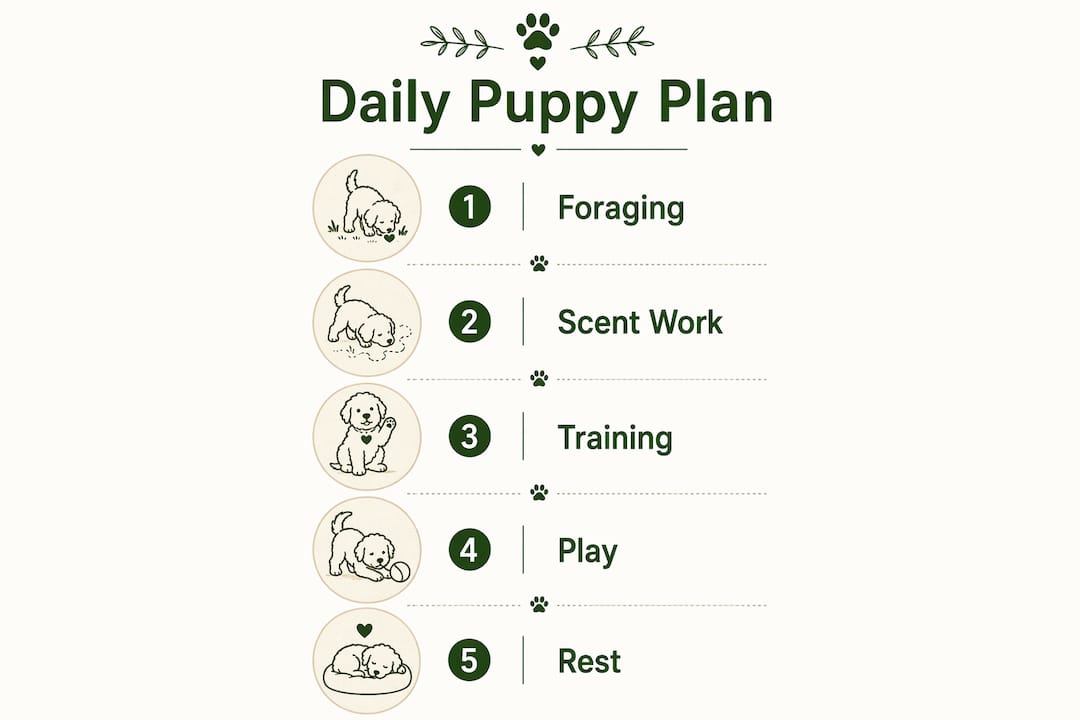
The attention span of a young puppy is short by design. Puppies do best with sessions of 3–10 minutes depending on age and arousal level. That is not a limitation to work around. It is the structure you build the whole plan around.
Pro Tip: Match the challenge to the puppy’s current skill level. A puzzle that is too hard the first time teaches a puppy to give up, not to persist. Start easier than you think you need to.
A simple 15-minute daily plan for your doodle puppy
The goal is not one long session. It is three short blocks spread across the day, each with a clear rhythm: movement, then sniffing or problem-solving, then calm licking or chewing. That repeatable indoor rhythm supports calm behavior better than a single exhausting play marathon.
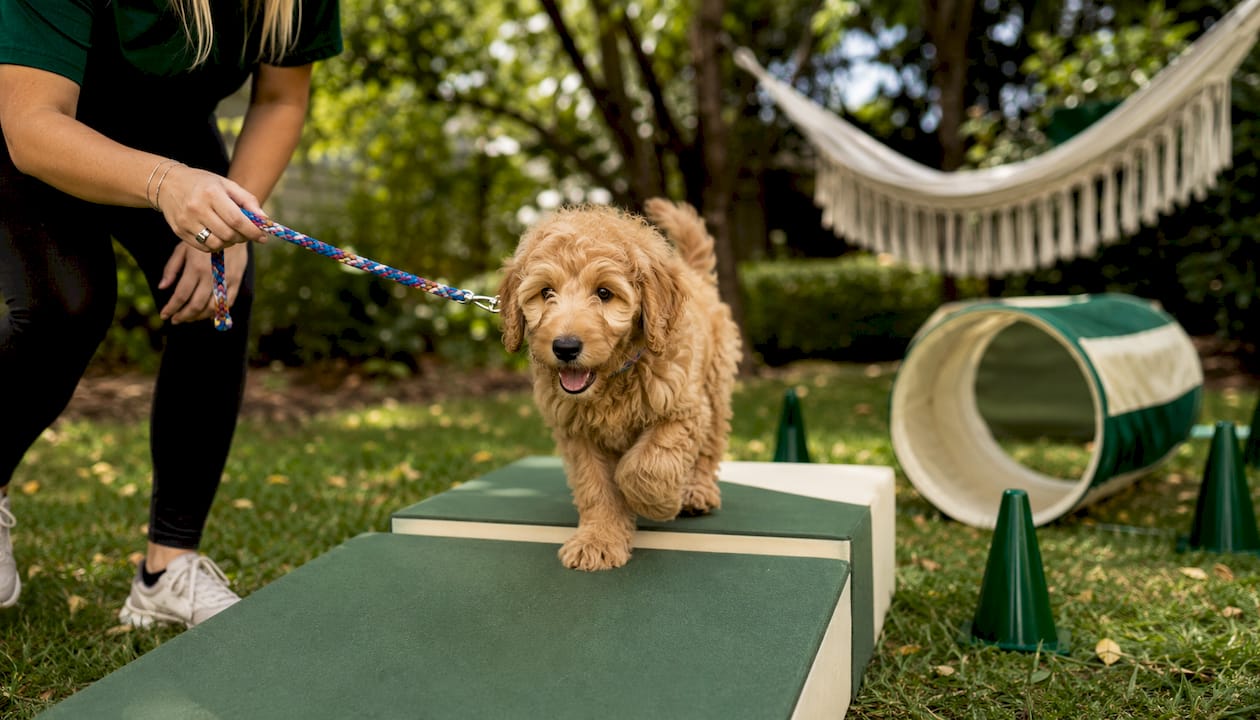
Here is a sample 15-minute daily block you can run right now:
| Time | Activity | Format |
|---|---|---|
| 3–5 min | Scatter feed or snuffle mat | Calm foraging |
| 3–6 min | Short training burst (one cue) | Cognitive work |
| 6–10 min | Frozen KONG or lick mat | Calm licking/settle |
| 10 min | “Find it” nose game | Sniffing/problem-solving | | 15 min | Easy win + end session | Reward and rest |
What to have ready before you start:
- A portion of your puppy’s daily kibble (use meals, not extra treats, to avoid overfeeding)
- A snuffle mat or a rolled towel with kibble tucked inside
- A stuffed and frozen KONG Classic
- A clicker or a verbal marker word (“yes”)
- A small handful of soft, pea-sized training treats
If your puppy gets frustrated mid-session: Stop immediately. Do not push through. Drop back to the easiest version of the activity, get one quick success, and end there. A frustrated puppy learns nothing useful and builds a negative association with the toy or game.
For a broader look at how to structure your puppy’s full day, a sample daily puppy schedule from Lakewoodranchdoodles walks through how to fit these blocks into feeding, nap, and play time.
Food puzzles and interactive toys: how to introduce them the right way
Food-based puzzles are the most accessible entry point for most owners, and they work because licking and foraging release endorphins. A puppy working a stuffed KONG is not just busy. It is genuinely calming itself.
The three tools worth starting with:
-
KONG Classic — stuff with wet food, xylitol-free peanut butter, or soaked kibble. Freeze it for several hours to extend the session and increase difficulty. A frozen KONG can occupy a puppy for an extended time and doubles as a teething soother.
-
Nina Ottosson-style puzzle feeders — sliding compartments and lift-able covers that require a puppy to problem-solve for each piece of kibble. Start with Level 1 (Beginner), where compartments are easy to open and rewards are immediately visible.
-
Snuffle mat — fabric loops that mimic grass and force nose-led foraging. A very brief bowl meal becomes a more extended mental workout.
The introduction step most owners skip: teach the puzzle before expecting independent play. Leave compartments open. Show your puppy the reward. Help them get the first few pieces before you close anything. A puppy who figures out the mechanism with your help will return to it confidently. One who hits a wall and quits learns to ignore the toy.
Pro Tip: Rotate between at least two or three different puzzle types across the week. Novelty is part of what makes these toys mentally demanding. A puzzle your puppy has solved 20 times in a row is no longer a puzzle.
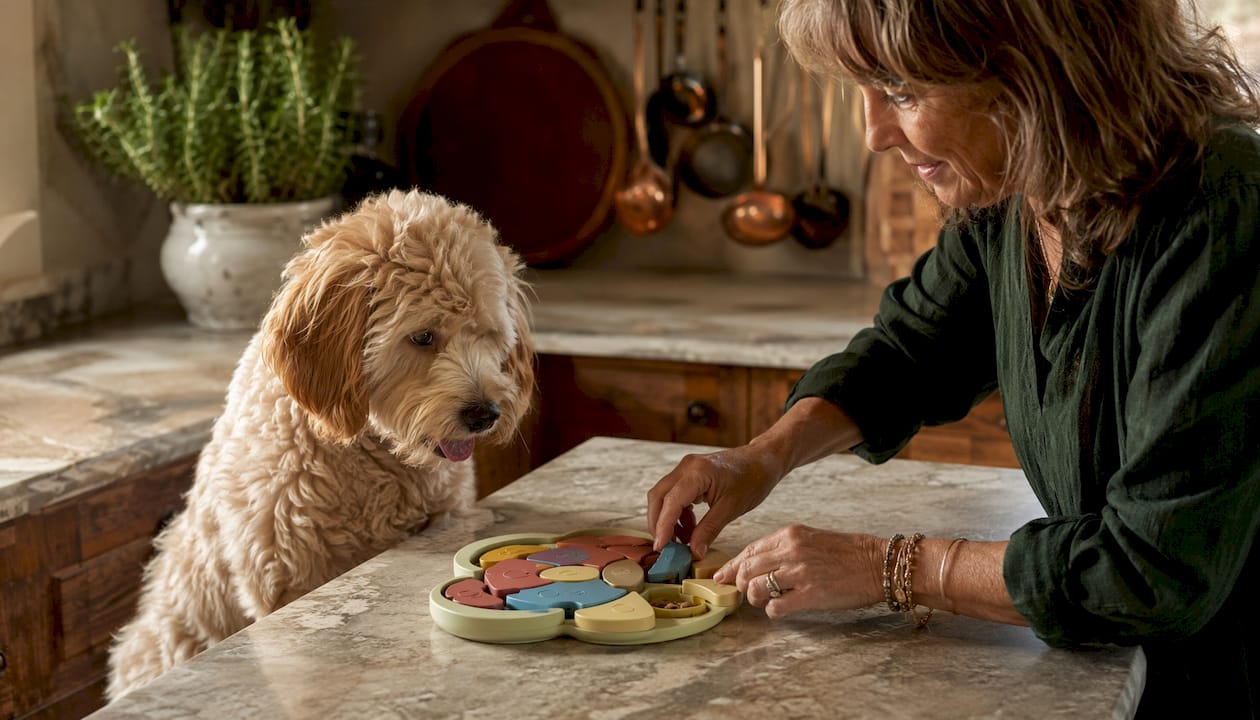
Safety notes: Supervise every session. Check soft rubber toys for chewed-off chunks before each use. Never use spreads with xylitol, grapes, raisins, or macadamia nuts. For teething puppies, frozen KONGs are gentler on sore gums than hard plastic puzzles. For general toy safety and supervision guidance, the MyPetsSafetyNet blog covers what to watch for during enrichment sessions.
Scent work and snuffle games: tapping your doodle’s foraging instincts
Nose work is the most underused tool in a puppy owner’s kit. A 10-minute sniffing session tires a puppy more thoroughly than 30 minutes of fetch, because processing scent information is genuinely cognitively demanding. It also has a calming effect that physical play does not.
The AKC’s scent work guidance recommends starting with simple “find it” games before introducing formal scent discrimination. Here is how to progress by age:
8–12 weeks: Scatter a few pieces of kibble on a snuffle mat or a patch of grass. Say “find it” and let your puppy sniff them out. Keep sessions to 3–5 minutes. The goal is just to build the association between the cue and the foraging behavior.
12–16 weeks: Start hiding kibble under a cup or inside a cardboard box with the flap open. Add a second cup. Let your puppy nose the right one over. Introduce a snuffle mat with kibble buried deeper in the loops.
4–6 months: Move to room searches. Place a treat under a chair, behind a door, or inside a paper bag. Give the “find it” cue and let your puppy work the room. You can also begin introducing a specific scented item (a cotton ball with a drop of birch or anise) as a target for more formal nose work.
When to stop a scent session: If your puppy dumps the snuffle mat, paws at it frantically without sniffing, or walks away entirely, the session has gone too long or the difficulty jumped too fast. Simplify immediately: scatter a few pieces of kibble openly on the floor and end there.
Training, tricks, and problem-solving: micro-sessions that double as brain work
A 2–3 minute training burst is one of the most efficient mental challenges for puppies because it requires sustained attention, impulse control, and active problem-solving. Done several times a day, these micro-sessions build a vocabulary of cues and a puppy who genuinely thinks before acting.
The structure that works:
- Pick one cue per session. Do not cycle through five behaviors in two minutes. One cue, repeated cleanly, with clear criteria.
- Cue → puppy offers behavior → mark (click or “yes”) → treat. Keep the loop tight. Mark the exact moment the behavior happens.
- 5–8 repetitions, then a 30-second break. Let your puppy sniff around or just rest. Then run another set if they are still engaged.
- End before they lose interest. The last repetition should be easy and successful.
Good starter cues for doodle puppies: touch (nose to palm), leave it, paw target, spin, and go to mat. Each scales in difficulty. “Touch” starts as a simple nose-to-hand game and eventually becomes a distance recall tool. “Go to mat” starts with one step and eventually becomes a reliable settle behavior.
Equipment you need: a clicker or a consistent verbal marker, small soft treats (pea-sized), and optionally a target stick for directional cues. For a deeper look at the positive reinforcement approach Lakewoodranchdoodles uses with every litter, their training page covers the philosophy and practical steps.
Clicker training is particularly effective with doodles because the precise timing of the mark removes ambiguity. Puppies learn faster when the feedback is instant and consistent.
8 DIY enrichment games you can make at home
These DIY enrichment games use items from your kitchen or recycling bin. Each one is short, supervised, and resettable.
- Muffin-tin puzzle (8–12 weeks+): Place kibble in each cup of a muffin tin. Cover each cup with a tennis ball. Your puppy noses or paws the balls off to reach the food. Start with only 3–4 cups covered.
- Towel roll (8–12 weeks+): Lay a hand towel flat, scatter kibble across it, and roll it loosely. Your puppy unrolls it to find the food. Supervise closely so they do not eat the towel.
- Cardboard box search (12–16 weeks+): Fill a shallow box with crumpled paper and a few empty toilet-paper rolls. Hide kibble throughout. Let your puppy dig and sniff. Remove any pieces they start to chew.
- Bottle puzzle (12–16 weeks+): Place a plastic water bottle (cap removed) on its side with kibble inside. Your puppy noses it to roll kibble out. Discard the bottle the moment it shows chew marks.
- Cup shuffle (12–16 weeks+): Place a treat under one of three cups. Let your puppy watch, then encourage them to find it. Start with just one cup so the win is guaranteed.
- Frozen KONG lick station (8–12 weeks+): Stuff a KONG with wet food or plain yogurt (no xylitol), freeze overnight, and place it in a shallow bowl. The bowl catches drips and keeps the session calm.
- Paper bag crinkle hunt (4–6 months+): Fold the top of a paper lunch bag loosely around a treat. Let your puppy figure out how to open it. Supervise so they do not ingest paper.
- Sniff-and-find box rotation (4–6 months+): Set out four or five cardboard boxes of different sizes. Hide a treat in only one. Let your puppy work through all of them. Rotate which box holds the treat each round.
Safety across all DIY games: Remove small parts before they become a choking hazard. Never use adhesive tape or staples inside a game. Supervise shredding behavior and redirect to a safe chew if your puppy starts eating the materials rather than searching them.
Mini obstacle courses and interactive play that make your puppy think
A puppy-safe obstacle course combines gentle physical movement with active decision-making. The cognitive load comes from navigating new surfaces, stepping over unfamiliar objects, and following directional cues. It is not about speed or athleticism. It is about body awareness and confidence.
Build a basic course with household items:
- A rolled bath towel on the floor to step over (low hurdle)
- A yoga mat or rubber bath mat as a “target” station to walk onto
- A cardboard box with both ends open as a short tunnel
- Two chairs with a broom handle resting loosely across them (low enough to walk under)
Walk your puppy through the course on leash the first time, rewarding each obstacle with a treat. Once they know the layout, use a target stick or a treat lure to direct them through independently.
Age and size modifications: For puppies under 16 weeks, keep every obstacle at ground level. No jumping, no steep inclines. Growth plates in doodle puppies are open until 12–18 months depending on size, so age-appropriate exercise matters. Standard and moyen-sized doodles need more conservative restrictions than minis.
Interactive play that requires thinking: Tug with rules (drop it on cue before the next pull) teaches impulse control. Hide-and-seek with a toy cue (show the toy, hide it, send your puppy to find it) builds scent discrimination and recall. Both are mentally demanding without being physically hard on a young body.
Surface traction matters. Avoid slippery floors for any obstacle work. A yoga mat or a rubber-backed rug gives puppies the grip they need to move confidently.
How to tell if your puppy is getting enough mental stimulation
The right amount of mental challenge produces a puppy who engages calmly, recovers quickly, and naps well after sessions. Too little and you get restless, destructive behavior. Too much and you get an overstimulated puppy who cannot settle.
Signs the challenge level is right:
- Calm, focused engagement during the activity
- Easy recovery: puppy settles or naps within 15–20 minutes after a session
- Willingness to approach the toy or game again the next day
- Reduced mouthing and chewing between sessions
Red flags for overstimulation:
- Harder biting or mouthing immediately after a session
- Zoomies that do not settle within a few minutes
- Ignoring food they normally love
- Crashing after chaotic play followed by another burst of frantic behavior
When you see overstimulation signs, do not add more excitement. Switch to a lick mat or a snuffle mat. Calm sensory activities bring arousal levels down faster than anything else.
Safety checklist for every session:
- Inspect toys for damage before use
- Use only xylitol-free foods
- Keep sessions to 10–15 minutes total (spread across the day)
- End on a win, not a failure
- Rotate activities so no single game becomes stale or frustrating
How Lakewoodranchdoodles structures mental stimulation for our litters
At Lakewoodranchdoodles, mental enrichment starts before puppies go home. By the time a litter reaches 6–7 weeks, they are already encountering textured surfaces, snuffle mats, and simple foraging games as part of their daily routine. That early exposure makes the transition to a new home significantly smoother.
Here is the age-based progression we recommend, and what we introduce at each stage:
- 8–12 weeks: Short sniff walks on varied surfaces, soft food puzzles (open KONG, scatter feed), and simple “find it” games. Sessions stay at 3–5 minutes. The goal is exposure and positive association, not skill.
- 12–16 weeks: Beginner puzzle feeders (Level 1 Nina Ottosson-style), cup shuffle games, and the first training micro-sessions (touch, sit, name recognition). Introduce the snuffle mat with kibble buried slightly deeper.
- 4–6 months: Frozen KONGs, box searches, more advanced puzzle levels, and the beginning of formal nose-work games. Training sessions can extend to 3–5 minutes and include two or three cues per session.
Sample weekly rotation:
| Day | Morning | Midday | Evening |
|---|---|---|---|
| Mon | Snuffle mat | Training burst | Frozen KONG |
| Tue | “Find it” game | Muffin-tin puzzle | Lick mat |
| Wed | Obstacle course | Scatter feed | Training burst |
| Thu | Towel roll DIY | “Find it” game | Frozen KONG |
| Fri | Training burst | Box search | Snuffle mat |
| Sat | Cup shuffle | Obstacle course | Lick mat |
| Sun | Rest/calm sniff walk | Scatter feed | Frozen KONG |
Common troubleshooting:
- Teething puppies ignoring hard toys: Switch to frozen KONGs and lick mats exclusively during heavy teething phases (around 12–16 weeks and again at 4–6 months).
- Puppy dumping the snuffle mat without sniffing: The kibble is too easy to see. Bury it deeper or switch to a mat with longer loops.
- Puppy losing interest in training after two repetitions: Your treats are not high-value enough, or the session is too long. Cut to 3–4 repetitions and use real chicken or cheese.
Lakewoodranchdoodles offers lifetime breeder support for exactly these moments. Whether you need help troubleshooting a puzzle introduction or figuring out why your puppy has suddenly stopped engaging with games they loved last week, we are a phone call or message away. For owners who want structured guidance, our puppy training resource page covers micro-session techniques and equipment in detail.
Pro Tip: Rotate the category of enrichment, not just the specific toy. A puppy who gets a different puzzle every day but always eats from a bowl is missing the foraging category entirely. Aim to hit sniff/forage, chew/lick, and cognitive/training at least once each day.
Key Takeaways
Doodle puppies need a daily mix of foraging, licking, and short training sessions to stay mentally healthy. Multiple short blocks spread across the day generally outperform one long session.
| Point | Details |
|---|---|
| Keep sessions short | Puppies do best with 3–10 minutes per activity; spread 10–15 minutes of total mental work across the day. |
| Mix three categories daily | Rotate sniff/forage, chew/lick, and cognitive/training so no single type dominates. |
| Teach puzzles gradually | Leave compartments open, demonstrate the mechanism, and reward small wins before increasing difficulty. |
| Watch for overstimulation | Harder biting, zoomies, and food refusal after a session mean the challenge level or duration was too high. |
| Lakewoodranchdoodles support | Lakewoodranchdoodles provides lifetime breeder support and an age-based progression plan owners can follow from 8 weeks onward. |
A breeder’s perspective on starting mental enrichment early
The puppies who arrive home already knowing what a snuffle mat is, already comfortable with a frozen KONG, already curious about new surfaces rather than frightened by them — those puppies settle into their new families faster. Not because they are inherently easier dogs, but because they have already learned that new things lead to good outcomes.
What most owners underestimate is how early the window opens. The AVSAB socialization period closes around 12–16 weeks, and the habits formed during that window shape behavior for years. A puppy who learns at 8 weeks that a puzzle toy is worth engaging with will approach novel challenges with confidence at 8 months. One who never encounters mental challenges until 6 months has already missed the period when those lessons land most deeply.
The other thing worth saying plainly: mental stimulation is not a substitute for good breeding. A puppy bred for service-animal temperament, with stable genetics and a calm, curious disposition, responds to enrichment differently than one bred without attention to behavioral traits. That is not a knock on any particular dog. It is just honest. The enrichment plan in this article works best when it starts with a puppy who is already wired to engage.
Lakewoodranchdoodles has spent over 20 years selecting for exactly that temperament. When owners reach out with questions about why their puppy is not engaging with a puzzle or seems overwhelmed by a new game, the answer is almost always in the progression. Too fast, too hard, too soon. Slow it down, make it easier, and let the puppy win.
Lakewoodranchdoodles lifetime support and your puppy’s enrichment starter kit
Every puppy from Lakewoodranchdoodles comes with something most breeders do not offer: a person on the other end of the phone who actually knows your dog’s lineage, temperament profile, and developmental stage. That lifetime support means you are never troubleshooting a puzzle toy or a training plateau alone.
For new owners, we put together a simple enrichment starter kit recommendation: a snuffle mat for daily foraging, a KONG Classic for frozen stuffing sessions, and a quick-reference laminated plan card with the weekly rotation schedule from this article. It is not a product we sell. It is a guide we hand to every family so they leave with a plan, not just a puppy.
If you are still choosing your puppy, our Goldendoodle puppy page and Bernadoodle puppy page show current availability and help you match the right size and cross to your household’s energy level. Smaller crosses like our Cockapoo puppies do well with shorter, more frequent bursts; standard-sized doodles can handle slightly longer sessions as they grow.
Ready to see who is available? Browse our available puppies or call us at 705 875 5195 to book a visit, in person or virtual.
Useful sources and further reading
| Source | What it covers | Why it’s useful |
|---|---|---|
| AKC: How to Teach Your Dog Scent Work | Step-by-step introduction to nose work and scent discrimination | Best starting point for owners who want to move beyond basic “find it” games |
| AKC: Clicker Training Your Dog | Mark-and-reward mechanics and timing for training micro-sessions | Covers why precise marking matters and how to build a reliable cue vocabulary |
| Guide Dogs for the Blind: Puppy Brain Games | Food-containing toys, gradual puzzle introduction, and calming lick behaviors | Practitioner-level guidance on teaching puzzles rather than just providing them |
| Zoomies Zone: Enrichment for Puppies by Age | Age-banded enrichment recommendations from 8 weeks through 6 months | Covers session length, activity types, and how to read a puppy’s arousal level |
| All About the Doodle: Exercise and Activities | Doodle-specific activity mix and daily exercise rule of thumb | Useful for understanding how brain games fit into a doodle’s total daily activity budget |
| ASPCA: General Dog Care | Foundational care guidance including safe food lists and supervision basics | Good reference for confirming safe and unsafe foods used in puzzle stuffing |
| MyPetsSafetyNet: Pet Safety Blog | Toy safety, supervision checklists, and responsible enrichment practices | Practical safety reference for owners setting up DIY games and puzzle sessions |