


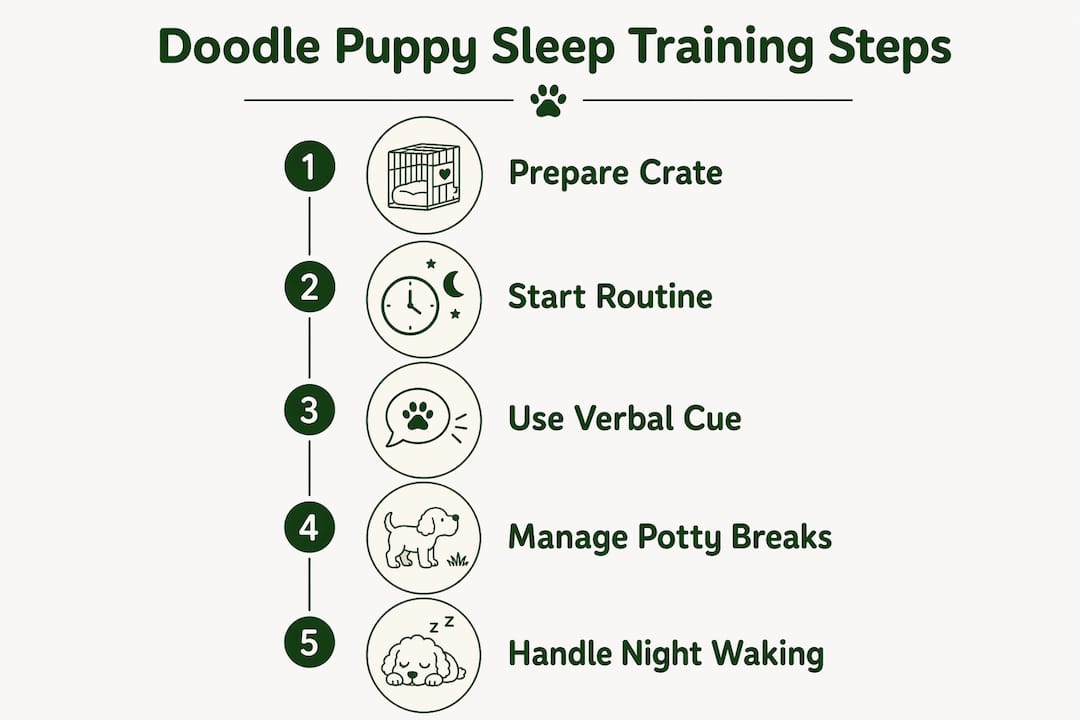
Getting your doodle puppy to sleep through the night comes down to three things: a consistent routine, a comfortable crate, and realistic expectations about how long it takes. Most doodle puppies, including Goldendoodles and Bernedoodles, sleep 18–20 hours daily and begin sleeping through the night reliably between 12 and 16 weeks of age, though some may take up to 20 weeks to adjust fully. Here is the core sequence to get you started:
- Set up the crate in your bedroom before your puppy arrives, lined with soft bedding and a scent item from the litter.
- Establish a wind-down window of 30–60 minutes before bed: calm play, no roughhousing.
- Feed the last meal by 5 PM and remove water 2–3 hours before bedtime.
- Take the final potty break between 10:00 and 10:30 PM. Wait until your puppy both urinates and defecates.
- Place your puppy in the crate calmly, cover three sides with a blanket, and keep the room dim and quiet.
- Set an alarm for 2 AM for a scheduled, silent potty trip. Return your puppy to the crate immediately after.
- Gradually push back the 2 AM trip by 15-minute increments as your puppy’s bladder capacity grows.
Stick to this sequence every night and most doodle puppies settle into a reliable sleep pattern within two to four weeks, with full overnight sleep consolidation usually reached between 12 and 16 weeks of age, sometimes up to 20 weeks.
Table of Contents
- How much sleep does a doodle puppy actually need by age?
- How to build a bedtime routine that actually works
- Crate training tips that make sleep training click faster
- Managing nighttime potty breaks without losing sleep
- Why doodle puppies wake at night and how to fix it
- What 20 years of breeding doodles teaches you about sleep training
- Ready to bring home a well-tempered doodle puppy?
- Key Takeaways
How much sleep does a doodle puppy actually need by age?
Young doodle puppies sleep far more than most new owners expect. The AKC confirms that puppies typically need 18–20 hours of sleep per day, with that number gradually decreasing as they mature. Sleep supports brain development, immune function, and muscle growth, so protecting those rest periods is not optional.
Both Goldendoodle and Bernedoodle puppies follow a similar developmental arc, though larger Bernedoodles may take slightly longer to consolidate overnight sleep due to their size and metabolic differences. The table below shows how sleep needs shift across the first year.
| Age | Daily Sleep Needed | Notes |
|---|---|---|
| 8–10 weeks | 18–20 hours | Frequent short naps; wakes for food and potty |
| 10–12 weeks | 18–20 hours | Nighttime sleep begins to consolidate |
| 3–6 months | 16–18 hours | Longer awake stretches; may start sleeping through |
| 6–12 months | 15–16 hours | More adult-like schedule emerging |
| 12+ months | 12 hours | Stable routine; sleeps when the household sleeps |
An 8-week-old puppy is only awake for roughly 4–6 hours spread across the entire day. If yours has been awake for more than 1–2 hours straight, a nap is overdue.
Signs your doodle puppy is ready for sleep:
- Getting nippy or mouthy with no provocation
- Zoomies or frantic, unfocused energy (often a sign of overtiredness, not excess energy)
- Ignoring commands they normally follow
- Yawning, heavy eyelids, or slowing down mid-play
- Excessive whining or barking without an obvious cause
Recognizing these cues early and guiding your puppy to their crate before they hit the overtired wall makes settling much faster. A puppy who has crossed into overtired territory takes significantly longer to calm down than one who is simply tired.
How to build a bedtime routine that actually works
Consistency is the whole game with a doodle puppy bedtime routine. Puppies read patterns, and once they associate a specific sequence of events with sleep, they begin winding down before you even put them in the crate.

Starting the wind-down 30–60 minutes before bedtime prevents the overtired “witching hour” that many new owners accidentally trigger by playing right up until lights out. Think of it as a decompression window, not dead time.
A practical evening sequence:
- 7:00–8:30 PM: Active play and a short training session. This is when you burn energy, not later.
- 8:30–9:30 PM: Wind-down begins. Sniffing games, calm chewing on a safe toy, gentle cuddles with the family.
- 9:00 PM: Remove the water bowl to reduce overnight potty needs.
- 9:30–9:45 PM: Quiet time. Dim the lights. Lower your voice. No fetch, no tug.
- 10:00–10:30 PM: Final potty break. Wait until your puppy actually goes, both urination and defecation.
- 10:30 PM: Crate time. Place your puppy in calmly, offer a chew toy or a small bedtime treat, close the door, and go to bed.
One technique worth knowing is the 10-10-10 rule: 10 minutes of training, 10 minutes of play, then 10 minutes of quiet time. It cycles energy down in stages rather than cutting activity off abruptly, which tends to produce a calmer, more settled puppy at crate time.
Pro Tip: If your puppy suddenly goes hyperactive around 9 PM, resist the urge to play it out. That burst of frantic energy usually means overtired, not under-exercised. Dim the lights, offer a chew toy, and let them decompress quietly. More play at that point makes settling harder, not easier.
Avoid big meals close to bedtime. The last meal should be no later than 5 PM so digestion is largely complete before the final potty break. A puppy with a full stomach at 10 PM is more likely to need a bathroom trip at 1 AM.
Crate training tips that make sleep training click faster
The crate is not a punishment. It is your puppy’s den, and how you set it up determines whether your puppy accepts it willingly or fights it every night. Get the setup right before your puppy comes home.
Crate setup checklist:
- Size: Big enough to stand, turn around, and lie down fully stretched. No larger. Excess space lets a puppy use one corner as a toilet, which undermines house training. Use a divider if the crate is sized for the adult dog.
- Location: Next to your bed, not in the kitchen or a separate room. A puppy in complete social isolation cries with far more intensity than one who can smell and hear you nearby.
- Bedding: Soft, washable fleece or veterinary bedding. Avoid wool or anything that can be chewed into strings.
- Scent item: A blanket or small toy from the breeder that carries the scent of the litter. This single item reduces first-night crying for many puppies.
- Cover: Drape a blanket over three sides (back, left, right) and leave the front open. This creates a den-like feel and reduces visual stimulation.
Heartbeat toys and warm water bottles wrapped in towels mimic the warmth and rhythm of sleeping beside littermates, which is genuinely calming for young puppies adjusting to their first nights alone. Many owners report a noticeable difference in how quickly their puppy settles with one of these in the crate.
Introduce the crate during the day before you ever use it at night. Feed meals inside it, toss treats in randomly, and let your puppy wander in and out freely. The goal is for the crate to feel like a familiar, rewarding place before bedtime ever arrives. You can find detailed crate training steps on the Lakewoodranchdoodles website if you want a full walkthrough.
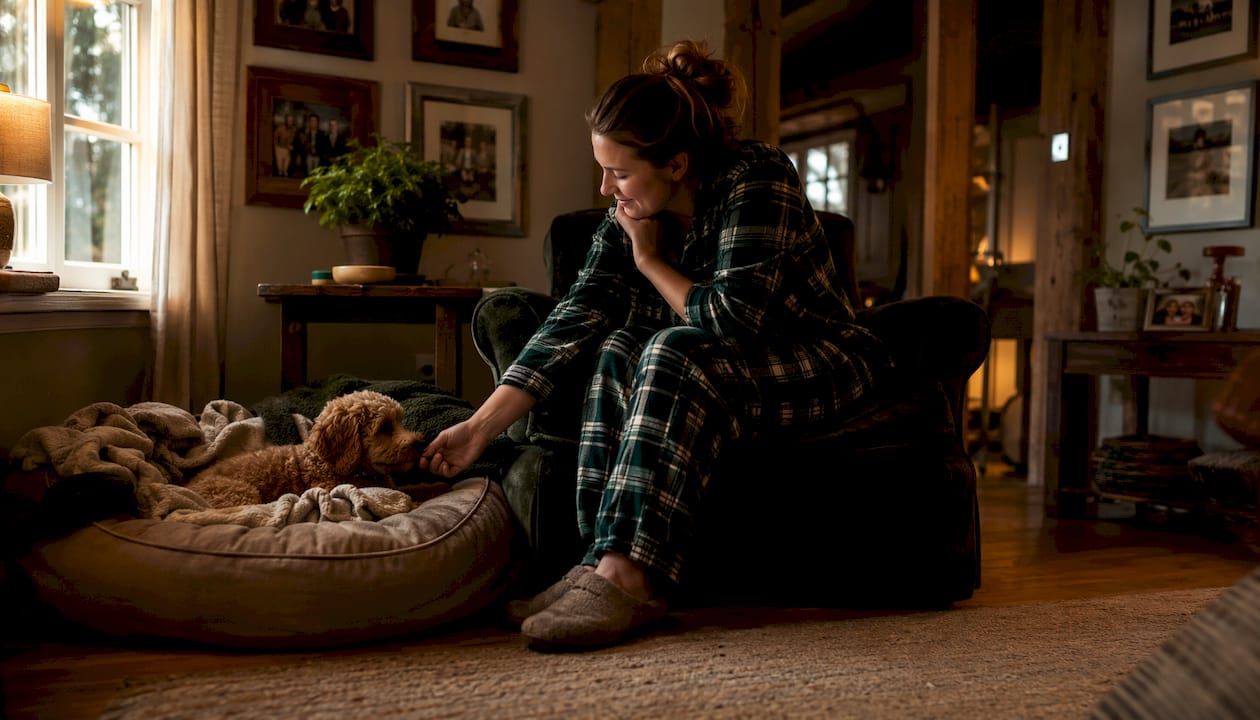
Avoid “cry it out” methods for young puppies. Placing the crate in your bedroom so your puppy can hear and smell you is the approach that produces the fastest settling, and it supports bonding without creating long-term dependency.
Managing nighttime potty breaks without losing sleep
Nighttime potty breaks are temporary. Handle them correctly and they shrink fast. Handle them poorly and you accidentally train your puppy to wake up expecting attention.
Experts recommend removing food and water 2–3 hours before bedtime, with the final meal no later than 5 PM and the last potty break between 10:00 and 10:30 PM. That timing gives the digestive cycle enough runway to finish before the overnight stretch begins.
How to run a nighttime potty break correctly:
- Keep lights low. Bright lights signal daytime to your puppy’s internal clock and make resettling harder.
- Say nothing. No greeting, no “good boy,” no conversation. Complete silence from crate to outside and back.
- Go directly to the potty spot. No detours, no play.
- If your puppy goes, offer one quiet, calm “good.” Return immediately to the crate.
- If your puppy does not go within five minutes, return them to the crate anyway.
The 2 AM trip is a scheduled management action, not a response to crying. That distinction matters. A trip that happens at a fixed time regardless of whether your puppy is crying does not reward waking. A trip that happens because your puppy cried at 2 AM does.
Gradually push back the 2 AM trip by 15-minute increments once your puppy is handling it consistently. This builds bladder capacity naturally without forcing accidents. Most puppies can handle a full night without a potty break by around 16–20 weeks of age, though some may require a bit longer to adjust. For a more detailed breakdown of nighttime toilet habits, Lakewoodranchdoodles has a practical potty training guide worth bookmarking.
Why doodle puppies wake at night and how to fix it
Not every nighttime waking means your puppy needs to go outside. Understanding the actual cause gets you to the right solution faster.
Teething discomfort is one of the most common culprits between 3 and 6 months. Sore gums make it hard to settle. Frozen treats, ice cubes, or a soft rubber chew toy in the crate can soothe the discomfort enough for your puppy to drift back off.
Separation anxiety shows up as persistent, escalating crying rather than the brief fussing that settles within 10–15 minutes. The fix is gradual independence building, not cold turkey isolation. Start with the crate next to your bed, then move it incrementally toward the door over several weeks once your puppy is sleeping comfortably.
Overtiredness is frequently mistaken for under-exercise. A puppy who becomes high-energy in the evening is usually overtired, not under-stimulated. Adding more play at that point makes things worse. Dim the environment, offer a chew toy, and let the nervous system settle on its own.
Crate aversion typically means the crate was introduced too fast or used as a punishment. Go back to daytime crate practice: feed meals inside, reward calm behavior in the crate, and build positive associations before expecting your puppy to sleep there overnight.
Behavioral cues that signal a genuine bathroom need:
- Circling or sniffing the crate floor
- Restlessness that escalates rather than fades
- Whining that starts suddenly after a period of quiet
- Pawing at the crate door
Crying that starts immediately at crate entry and fades within 10–15 minutes is usually adjustment fussing, not a bathroom signal. Crying that starts after a quiet period and intensifies is more likely a real need. Learning to read the difference takes a few nights, but it becomes clear quickly.
What 20 years of breeding doodles teaches you about sleep training
At Lakewoodranchdoodles, over two decades of raising Goldendoodles and Bernedoodles with service-animal-quality temperaments has produced a clear picture of what actually works and what new owners tend to get wrong.
The single most common mistake is inconsistency in the first two weeks. Owners who stick rigidly to the routine see puppies settling within 3–5 nights. Owners who cave to crying, bring the puppy into bed, or skip the scheduled potty trip find themselves dealing with the same problems at 12 weeks that they had at 8 weeks.
Breeder-backed tips from Lakewoodranchdoodles:
- Ask your breeder for a scent item before pickup day. A small cloth kept in the whelping area for a few days carries the smell of the litter and the mother. It is one of the most effective calming tools available and costs nothing.
- Goldendoodle puppies tend to be highly social and may vocalize more on the first few nights than Bernedoodle puppies, who are often calmer by temperament. Neither is a problem. Both respond well to the same routine.
- Daytime naps are not optional. A puppy who skips naps during the day will be overtired and harder to settle at night. Enforce naps by placing your puppy in the crate with a chew and walking away. Most puppies settle within 10 minutes.
- The evening routine should combine training, play, and quiet time in that order, not the reverse. Ending the evening with training or play keeps the nervous system activated.
- Gradual transitions from proximity to independence work better than sudden moves. Once your puppy sleeps reliably through the night with the crate next to your bed, move it a foot or two toward the door. Repeat over several weeks until it reaches its permanent location.
Pro Tip: Pair the crate with a consistent verbal cue, something like “bedtime” or “settle,” said in the same calm tone every night. Within a few weeks, that word alone begins to trigger a wind-down response. Puppies bred for trainability, like Goldendoodles and Bernedoodles, pick this up faster than most owners expect.
For broader puppy training tips that complement sleep training, a structured approach to the full training picture makes the sleep piece easier because your puppy already understands how to follow cues and settle on command.
Lakewoodranchdoodles offers lifetime breeder support from the day your puppy comes home through their senior years. If you hit a wall with sleep training, reach out directly at 705 875 5195 or book a virtual visit. The answers are usually simpler than they seem at 2 AM.
Ready to bring home a well-tempered doodle puppy?

Sleep training goes smoothly when it starts with a puppy bred for calm temperament and exceptional trainability. At Lakewoodranchdoodles, every Goldendoodle and Bernedoodle puppy is raised with over 20 years of hands-on experience, socialized from birth, and prepared for the transition to your home. Browse current litters and upcoming availability on the available puppies page or call 705 875 5195 to schedule a visit.
Key Takeaways
Most doodle puppies sleep through the night consistently within the first few months when owners follow a structured routine from the first night home.
| Point | Details |
|---|---|
| Sleep needs by age | Puppies need extensive daily sleep during their early weeks, with gradual decreases as they mature. |
| Crate placement matters | Keeping the crate next to your bed reduces crying and speeds up settling compared to a separate room. |
| Final potty timing | Schedule the last potty break between 10:00 and 10:30 PM and the last meal no later than 5 PM. |
| Scheduled 2 AM trip | Take the 2 AM potty break at a fixed time regardless of crying; gradually push it back in 15-minute increments. |
| Overtiredness vs. energy | Evening hyperactivity in puppies usually signals overtiredness, not a need for more play. |