


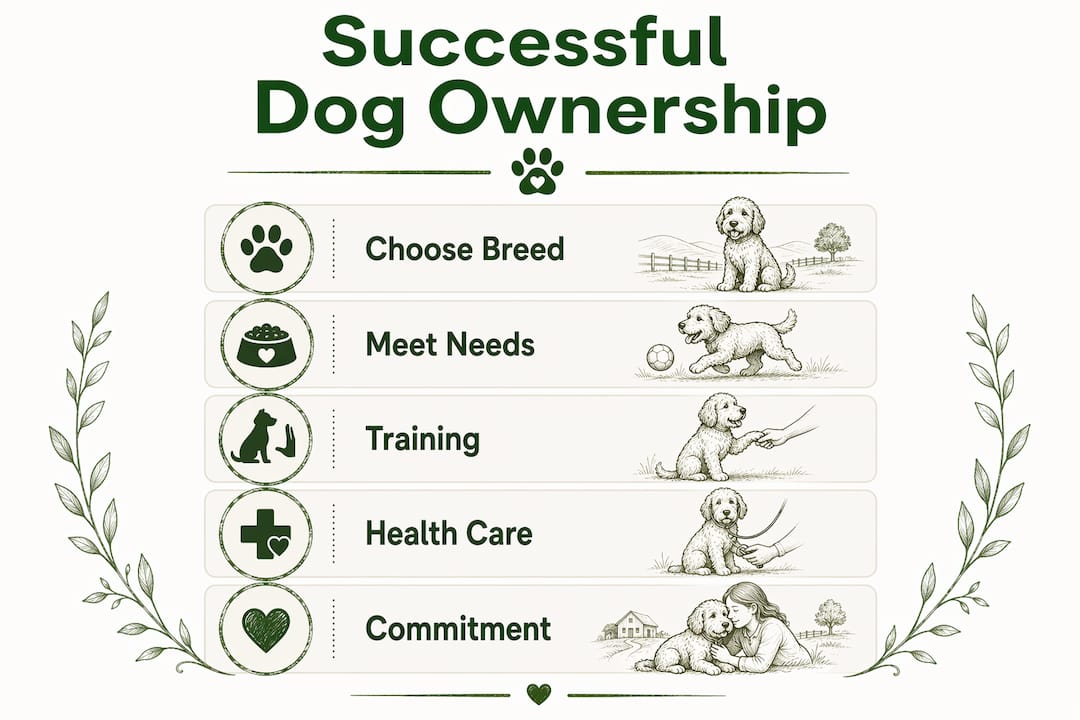
Successful dog ownership means consistently meeting your dog’s physical, emotional, social, and medical needs across their entire life, not just during the exciting early months. It requires deliberate choices before you even bring a dog home, and sustained commitment long after the puppy phase fades. The owners who get this right share a few things in common: they plan ahead, they train with patience, and they treat their dog’s well-being as a daily practice rather than a checklist.
The core foundations of responsible dog parenting come down to five things:
- Lifelong veterinary care, including preventative health, vaccinations, and parasite control
- Proper nutrition calibrated to your dog’s age, size, and health status
- Daily exercise and mental stimulation matched to breed and energy level
- Positive, reward-based training that builds trust and clear communication
- Emotional presence, including predictable routines, bonding time, and calm leadership
Responsible ownership also means being accountable to your community, keeping your dog safe and well-mannered in public, and adapting your care as your dog ages from puppy to senior.
What successful dog ownership looks like day to day
The habits that separate great dog owners from average ones are less about grand gestures and more about consistency. A dog thrives on predictability. Feeding at the same times, walking the same routes, training in short daily sessions — these routines build the trust and security your dog needs to feel settled.
- Choose a dog that fits your actual life, not your ideal life. A high-energy breed in a small apartment without daily outdoor access is a setup for behavioral problems.
- Build a daily routine around feeding, exercise, and at least one short training session.
- Use positive reinforcement every time you want to encourage a behavior. Dogs trained with reward-based methods show fewer stress behaviors and learn faster than those trained with aversive techniques.
- Set clear household rules from day one. If something is acceptable today, your dog will assume it is always acceptable.
- Avoid unsupervised interactions with unfamiliar dogs, especially in the early months.
- Monitor your dog’s mood and body language daily. Changes in appetite, energy, or behavior are often the first signs something is off.
“Training is communication and trust building, not control. Well-trained dogs are safer, more confident, and enrich daily life.” A dog that understands what you expect from them is a dog that can relax, because the rules are clear and the relationship feels secure.
How to choose a dog breed that actually fits your lifestyle
Picking the wrong breed is one of the most common and most preventable mistakes in dog ownership. A mismatch between your lifestyle and your dog’s needs creates stress for both of you, and it often shows up as behavioral problems that feel impossible to fix.
- Assess your household honestly. How much space do you have? How many hours per day is the dog alone? Do you have children or other pets?
- Research breed-specific energy levels. Some breeds need two or more hours of vigorous exercise daily. Others are content with a couple of short walks.
- Factor in grooming demands. Doodle breeds like Goldendoodles and Bernedoodles have low-shedding coats that require regular professional grooming every 6–8 weeks.
- Think about long-term health costs. Larger breeds tend to have shorter lifespans and higher veterinary costs. Some breeds carry genetic predispositions to specific conditions.
- Consider temperament, not just appearance. A dog bred for herding or guarding has instincts that don’t disappear just because they live in a suburban home.
- Work with a reputable breeder or rescue. A responsible breeder, as the AKC recommends, will ask you detailed questions about your home and lifestyle because they care about the match as much as you do.
Lakewoodranchdoodles breeds Goldendoodles, Bernedoodles, and Cockapoos specifically for family-compatible temperaments, trainability, and health, with over 20 years of experience matching families to the right dog.
How to meet your dog’s physical and emotional needs effectively
Dogs need more than food and shelter; understanding their emotional needs is essential for their well-being. They need engagement, structure, and a sense of belonging. Owners who understand this tend to have calmer, more confident dogs.
- Exercise daily, adjusting intensity for age and breed. A senior dog needs gentle movement; a young Labrador needs a real workout.
- Feed a balanced diet with portion control. Table scraps should stay below 10% of total daily caloric intake to avoid obesity and the health problems that follow.
- Create a dedicated resting space your dog can retreat to. A crate, a dog bed in a quiet corner, or a defined zone gives them a sense of security.
- Socialize consistently with people, children, other dogs, and new environments, especially during the critical window before 14–16 weeks.
- Spend intentional bonding time every day. Play, grooming, and calm companionship all count.
Pro Tip: Learn to read subtle stress signals before they escalate. Yawning, lip-licking, and “whale eye” (showing the whites of the eyes) are early indicators that your dog is uncomfortable. Catching these early lets you intervene calmly rather than reacting to a bigger behavioral response.
The human-animal bond actively reduces owner stress, anxiety, and blood pressure when the relationship involves genuine engagement and planning. The benefits run both ways.
Common mistakes that undermine good dog ownership
Most dog ownership problems are not caused by bad intentions. They come from gaps in knowledge, inconsistency, or underestimating what a dog actually needs.
- Stopping training too soon. Training is a lifelong practice, not a puppy-phase project. Adult behavior builds directly on the foundation you lay in the first year.
- Ignoring breed compatibility. Getting a dog because it looks appealing, without researching its needs, leads to frustration on both sides.
- Feeding out of guilt. Giving extra food or treats to compensate for time away is one of the fastest routes to canine obesity, which shortens lifespan and increases veterinary costs.
- Skipping supervision. Unsupervised dogs, especially young ones, get into situations that are dangerous or that reinforce bad habits.
- Delaying veterinary care. Waiting until a problem is obvious usually means the problem has been developing for a while. Preventative care catches issues early.
- Neglecting socialization. A dog that is not regularly exposed to new people, animals, and environments becomes anxious or reactive. That anxiety rarely improves on its own.
The hardest stretch for most owners is the adolescent phase, roughly months 4–6, when teething peaks and a previously responsive puppy seems to forget every command. Consistency through this period, not backing off, is what produces a well-adjusted adult dog.
Health, safety, and grooming routines your dog needs
Preventative care is far less expensive and far less stressful than treating problems after they develop. The AVMA guidelines on responsible ownership are built around this principle: establish a veterinarian relationship early, keep vaccinations current, and maintain parasite control year-round.
- Schedule annual wellness exams, or more frequently for puppies, seniors, and dogs with known health conditions.
- Stay current on vaccinations and parasite prevention, including heartworm, flea, and tick protection through all seasons.
- Groom regularly based on coat type. Doodle coats need brushing several times per week and professional grooming every 6–8 weeks to prevent matting.
- Brush your dog’s teeth at least a few times per week. Dental disease is one of the most common and most preventable health issues in dogs.
- Keep ID tags current and consider microchipping. The AVMA specifically recommends proper identification, including microchips with updated registration, as a core ownership responsibility.
- Supervise outdoor activity and adjust exercise for weather conditions. Hot pavement, extreme cold, and off-leash areas all carry specific risks.
| Care Area | Recommended Frequency | Why It Matters |
|---|---|---|
| Veterinary wellness exam | Annually (puppies: every 3–4 weeks until 16 weeks) | Catches health issues early |
| Vaccinations | Per vet schedule | Prevents serious infectious disease |
| Parasite prevention | Year-round | Protects against heartworm, fleas, ticks |
| Professional grooming | Every 6–8 weeks (doodle coats) | Prevents matting and skin issues |
| Dental brushing | 3–4 times per week | Reduces dental disease risk |
| Nail trimming | Every 3–4 weeks | Prevents discomfort and joint strain |
What experts say about responsible dog ownership and training
The most experienced trainers and veterinary professionals frame dog ownership as stewardship. That word matters. Stewardship means proactively meeting all of a dog’s needs rather than responding only when something goes wrong.
- Reward-based training produces measurably better outcomes. Dogs trained with positive reinforcement show fewer stress behaviors and build confidence faster than those trained with punishment or correction-based methods.
- The 3-3-3 rule gives new owners a practical framework: expect 3 days for initial decompression, 3 weeks to learn household routines, and 3 months to fully settle into the relationship. Patience during this window pays off significantly.
- Keep early training sessions short. Sessions of 5–10 minutes prevent mental fatigue and keep your dog engaged and successful.
- Plan for life stages. A dog’s needs at 2 years are different from their needs at 10. Owners who adapt their care as the dog ages avoid a lot of preventable health and behavioral problems.
- Emergency preparedness matters. Having a plan for unexpected veterinary costs, a trusted pet sitter, and a vet you already have a relationship with makes a real difference when something goes wrong.
Reward-based training reduces stress behaviors in dogs compared to aversive methods, and dogs trained this way learn tasks faster. The American Kennel Club recommends beginning training as early as 7–8 weeks, with short sessions focused on foundational commands.
Why your dog’s individuality deserves real respect
Every dog is a distinct individual, even within the same breed or litter. Two Goldendoodles raised in the same household can have completely different thresholds for noise, different social preferences, and different ways of showing affection or stress. Treating your dog as a generic representative of their breed, rather than as a specific animal with their own personality, leads to misread signals and missed opportunities.
Some dogs are naturally social and bounce back quickly from new experiences. Others need more time and a quieter introduction to unfamiliar people or environments. Neither is wrong. Recognizing which type of dog you have, and adjusting your expectations accordingly, is one of the less-discussed but genuinely important aspects of caring for your dog well.
Respecting individuality also means not pushing a dog past their comfort threshold to meet your social goals. A dog that is forced into repeated overwhelming situations does not become braver. They become more anxious. Progress comes from gradual, positive exposure at a pace the dog can handle.
The long-term commitment and real costs of dog ownership
A dog is a commitment that usually spans over a decade, and the financial reality deserves honest attention before you bring one home. The first year carries considerable expenses, and ongoing costs vary based on food, grooming, preventative care, and training needs. Emergency veterinary visits can add significant costs for common issues like injuries or foreign body ingestion.
Beyond money, the time commitment is real. Dogs need daily exercise, feeding, training reinforcement, and companionship. A dog left alone for long stretches without mental stimulation or social contact develops anxiety, destructive behavior, or both. Planning for this before you get a dog, not after, is what separates owners who thrive from those who struggle.
The AVMA frames lifelong care as a core ownership responsibility, including making reasonable arrangements if your circumstances change and you can no longer provide that care. That level of accountability is what responsible dog parenting actually looks like.
The emotional rewards and real challenges of living with a dog
The human-animal bond carries genuine health benefits: reduced stress, lower anxiety, and improved blood pressure are all associated with active, engaged dog ownership. Dogs offer a kind of unconditional presence that most people find genuinely grounding, especially during difficult periods.
The challenges are just as real. Behavioral problems, unexpected health crises, the grief of losing a dog, and the daily logistics of working your schedule around another living creature’s needs all take a toll. New owners often underestimate the adjustment period, both for themselves and for the dog. The first few months can feel relentless.
What gets owners through the hard parts is usually the relationship itself. A dog that trusts you, that comes running when you call and settles calmly beside you at the end of the day, is the direct result of the consistency and care you put in. That payoff is real, and it compounds over years.
Key Takeaways
Successful dog ownership requires a lifelong commitment to meeting your dog’s physical, emotional, social, and medical needs through consistent daily habits, positive training, and proactive health care.
| Point | Details |
|---|---|
| Lifelong commitment | Dog ownership spans many years and requires consistent care, planning, and financial readiness. |
| Positive training works | Reward-based training reduces stress behaviors and builds faster learning than aversive methods. |
| Breed compatibility matters | Matching a dog’s energy, size, and temperament to your lifestyle prevents most behavioral problems. |
| Preventative health saves money | Annual vet exams, vaccinations, and parasite control catch problems early and cost less than reactive treatment. |
| Respect your dog’s individuality | Each dog has a distinct personality; adjusting your approach to their specific needs strengthens the bond. |
Ready to start your journey with the right dog?
At Lakewoodranchdoodles, we have spent over 20 years matching families with dogs bred for health, temperament, and trainability. Our Goldendoodles, Bernedoodles, and Cockapoos are raised with service-animal-quality care from day one, and we provide lifetime breeder support so you are never navigating ownership alone.
Browse our available puppies or explore our Goldendoodle puppies to find the right match for your home and lifestyle. We do daily visits by appointment and virtual visits for families who want to connect before committing. Call us at 705 875 5195 or visit us at Lakewoodranchdoodles to learn more.