


Most puppies fall into five recognizable temperament archetypes: the Social Butterfly, the Cautious Observer, the Independent Thinker, the Chill/Laidback, and the High-Energy Adventurer. When you visit a litter, the single most useful thing you can do in the first five minutes is watch how each puppy responds to three things: your arrival (social greeting), an unfamiliar sound, and a novel object placed on the floor. That trio of responses tells you more than any breed chart.
Here’s how those archetypes map to common household types at a glance:
- Social Butterfly: Families with kids, first-time owners, multi-pet homes
- Cautious Observer: Quieter households, patient owners, adults-only or one-dog homes
- Independent Thinker: Experienced owners who enjoy training challenges, active singles or couples
- Chill/Laidback: Retirees, low-activity households, seniors, apartment dwellers
- High-Energy Adventurer: Active families, runners, homes with large yards, owners who want a sport or agility dog
One caveat worth stating upfront: temperament is a starting point, not a fixed verdict. Early socialization and environment shape outcomes just as much as what you observe at eight weeks.
Table of Contents
- What is puppy temperament, and why does it matter for selection?
- The five puppy temperament archetypes: signs, ideal owner, and training priorities
- When can you reliably read a puppy’s temperament?
- How to observe and test a puppy’s temperament during a visit
- Red flags in puppy behavior: what warrants professional help
- How to match a puppy to your household: a practical checklist
- What Lakewoodranchdoodles looks for in the first five minutes with a litter
- Key Takeaways
- What 20 years of litter placements actually teaches you
- Lakewoodranchdoodles helps you find the right match from day one
- Useful sources and further reading
What is puppy temperament, and why does it matter for selection?
Temperament refers to the biologically-based behavioral tendencies a dog is born with: how it responds to novelty, stress, social contact, and stimulation. It differs from trained behavior in that it reflects the dog’s baseline wiring, not what it has learned. As researcher Dr. Jessica Hekman puts it, temperament is determined by genetics but can be modified by environment and experience.
Genetics set the range; early environment determines where within that range a puppy lands. The uterine environment, how the mother cares for the litter, and how littermates interact all influence behavioral development before you ever meet the puppy. This is why litter-of-origin often explains more personality variability than breed or sex alone. A Goldendoodle from a calm, well-socialized litter will behave very differently from one raised in a chaotic or understimulating environment, even if both carry the same breed mix.
The socialization window closes faster than most people expect. According to the Merck Veterinary Manual, dogs are most receptive to learning how to handle new situations until about 16–20 weeks of age, with the critical window for human socialization running from roughly 5–12 weeks. After that, new experiences become harder to process without stress. Social maturity, however, continues developing until 12–36 months, meaning the puppy you bring home at eight weeks will keep changing well into its second year.
Breed line matters too. A dog from a working line carries different temperamental tendencies than one from a pet or show line, even within the same breed. Asking a breeder about parent-line temperament is not just polite conversation; it is one of the most predictive data points available to a buyer.
- Temperament = baseline behavioral tendencies (genetic + prenatal environment)
- Trained behavior = what the dog has learned through experience
- Social maturity completes between 12–36 months, not at eight weeks
- Litter environment often predicts puppy behavior better than breed alone
- Socialization window: 5–12 weeks for people
Pro Tip: Ask the breeder two specific questions before you visit: “How does the mother behave around strangers?” and “What household sounds and surfaces have the puppies been exposed to?” Those answers tell you more about likely temperament than the breed name on the listing.
The five puppy temperament archetypes: signs, ideal owner, and training priorities
These five archetypes are the practical categories breeders and trainers use most often. None is “better” than another. The goal is fit.
Social Butterfly
Observable signs: Runs toward you immediately, tail up, seeks eye contact, initiates play with littermates, recovers quickly from a startle.
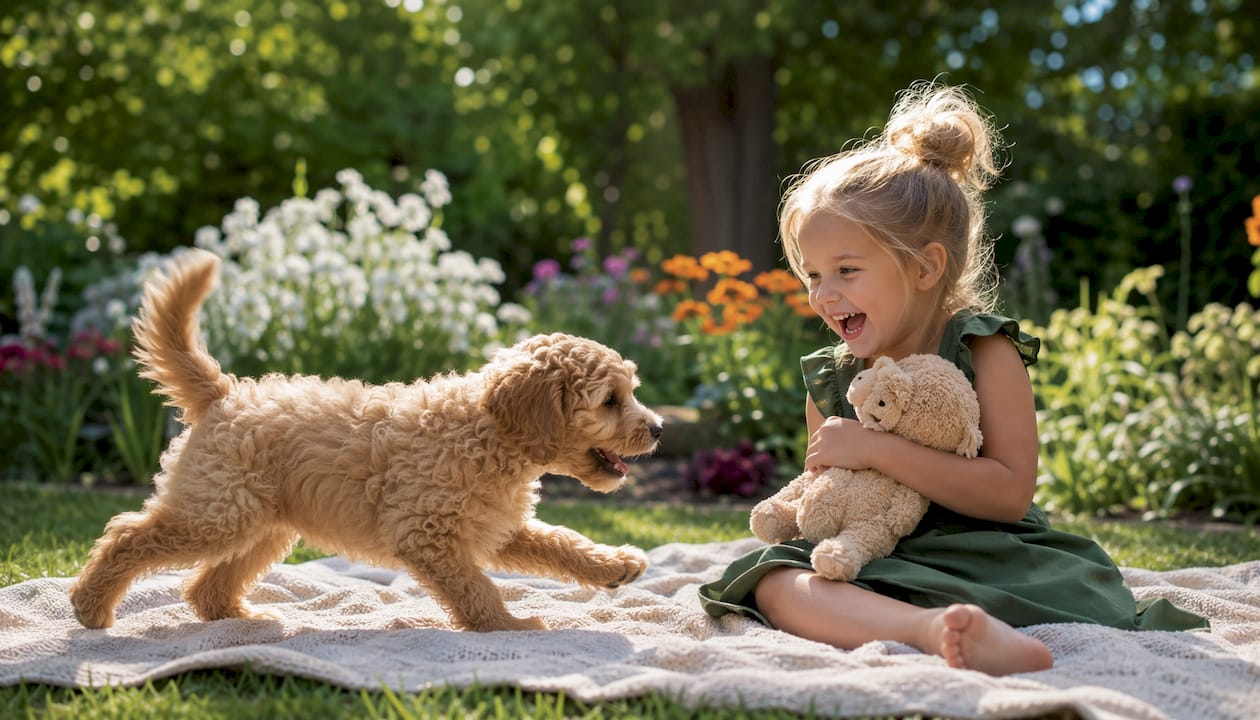
Ideal household: First-time owners, families with children, multi-dog homes, anyone who wants a dog that integrates easily into social situations.
Week-one training priorities: Teach a default sit before greetings to prevent jumping. Start leash manners early because this puppy will pull toward every person it sees. Channel enthusiasm into structured play rather than trying to suppress it.
Red flag specific to this type: Frantic, non-stop attention-seeking that does not settle even after exercise can indicate anxiety rather than sociability. Watch for the difference between a puppy that greets you and then settles versus one that cannot stop demanding contact.
Cautious Observer
Observable signs: Hangs back when you enter, watches before approaching, may crouch or tuck tail briefly, warms up slowly but steadily, prefers one-on-one over group chaos.
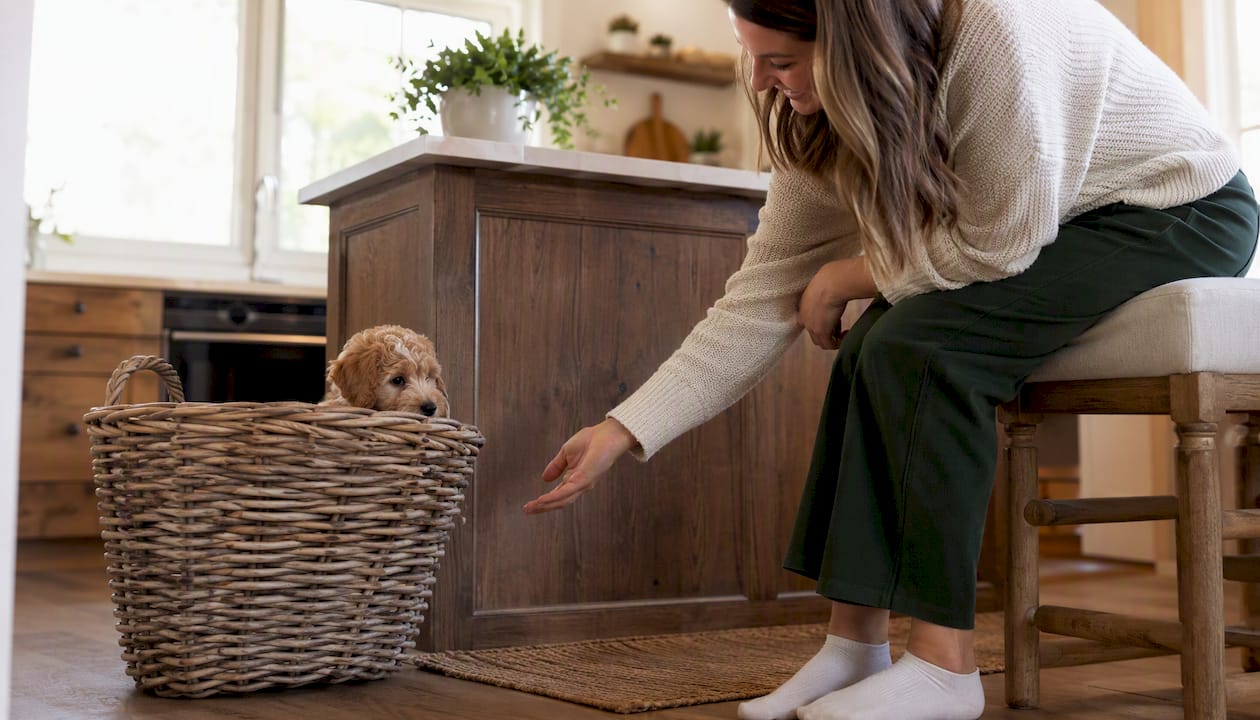
Ideal household: Quieter homes, patient adults, households without very young children who may overwhelm the puppy, experienced owners who understand that slow warm-up is not a flaw.
Week-one training priorities: Short, low-pressure sessions. Let the puppy approach you, never force contact. Pair every new experience with high-value food. The socialization guide from Lakewoodranchdoodles covers exactly this graduated exposure approach.
Red flag: A puppy that freezes, refuses food in new environments, or shows no improvement after repeated gentle exposure warrants a conversation with a veterinary behaviorist.
Independent Thinker
Observable signs: Explores the room on its own terms, investigates novel objects confidently but without needing your approval, may ignore you briefly in favor of a scent trail, problem-solves rather than panics.
Ideal household: Experienced owners who enjoy training, active households, people who want a dog that can work independently (hiking off-leash, agility, scent work).
Week-one training priorities: Establish clear, consistent rules from day one. This puppy is not stubborn; it is persistent, and that persistence is trainable with reward-based methods. Mental challenges (puzzle feeders, scent games) matter as much as physical exercise.
Red flag: Persistent ignoring of recall in high-distraction environments by 12 weeks suggests the owner needs professional help with engagement training before bad habits solidify.
Chill/Laidback
Observable signs: Relaxed body posture, moderate interest in novelty, settles easily after play, not the first to initiate but participates when invited, comfortable being handled.
Ideal household: Retirees, apartment dwellers, low-activity households, owners who want a calm companion rather than a sport dog.
Week-one training priorities: Do not mistake calm for low intelligence. This puppy still needs daily mental stimulation and consistent training. Boredom in a laidback dog often shows up as quiet destructiveness rather than hyperactivity.
Red flag: A puppy that is lethargic rather than calm, shows no interest in play or food, or seems disconnected from its environment may have a health issue rather than a laidback temperament. Check with your vet.
High-Energy Adventurer
Observable signs: First to the gate, bouncing, mouthing, short attention span during calm moments, high arousal around novel stimuli, recovers from rest quickly.
Ideal household: Active families, runners, homes with outdoor space, owners committed to daily structured exercise and mental work.
Week-one training priorities: Impulse control before anything else. “Sit” and “wait” are the foundation. Managing mouthing is a day-one priority with this type. Structured play sessions with clear start and stop cues prevent the puppy from learning that chaos is the default state.
Red flag: Inability to settle at all after adequate exercise, combined with destructive behavior, can signal anxiety or an unmet medical need rather than normal high energy.
| Archetype | Energy Level | Sociability | Trainability | Best Home Match |
|---|---|---|---|---|
| Social Butterfly | Moderate–High | Very High | High | Families, first-time owners |
| Cautious Observer | Low–Moderate | Moderate | Moderate | Quiet adults, patient owners |
| Independent Thinker | Moderate–High | Moderate | High (with motivation) | Experienced, active owners |
| Chill/Laidback | Low–Moderate | Moderate | Moderate–High | Retirees, low-activity homes |
| High-Energy Adventurer | Very High | High | Moderate (needs structure) | Active families, sport owners |
When can you reliably read a puppy’s temperament?
The honest answer: partially at 6–8 weeks, and fully only after social maturity. Purdue’s canine welfare research confirms that temperament signals become discernible between 6–8 weeks, but social maturity continues developing until 12–36 months. What you see at eight weeks is a real signal, not a complete picture.
Formal tests like the Volhard Puppy Aptitude Test (PAT) are useful as brief snapshots, but their predictive validity for adult behavior is limited, especially when used before eight weeks. A puppy that scores as “dominant” at seven weeks may settle into a cooperative adult with the right socialization. The test highlights areas to work on, not a fixed destiny.
| Age Window | What You Can Observe | Reliability |
|---|---|---|
| 6–8 weeks | Basic boldness/shyness, social interest, startle recovery | Moderate |
| 12–36 months | Full social maturity, adult behavioral patterns | High |
Two practical rules help owners set realistic expectations after bringing a puppy home. The 3-3-3 rule is a widely used informal guideline: roughly three days to decompress, three weeks to build routines, and three months to feel truly at home. It is not a scientific protocol, but it maps well to what most owners observe. The 7-7-7 concept (exposing a puppy to seven new people, places, and experiences in its first weeks) is similarly informal but reflects the principle behind the socialization window research.
Pro Tip: Schedule a follow-up temperament check at six months and again at twelve months. Adolescence (roughly 6–18 months) often brings a temporary spike in reactivity or independence that owners mistake for permanent regression. It is usually developmental, not a sign something went wrong.
How to observe and test a puppy’s temperament during a visit
You do not need a formal test battery. A structured 5–10 minute observation, done consistently across every puppy you evaluate, gives you reliable comparative data.
- Enter calmly and sit on the floor. Let the puppies come to you. Note which ones approach immediately, which hang back, and which ignore you entirely.
- Offer a gentle hand. Extend your hand low, palm up. Watch for confident sniffing, cautious approach, or avoidance. Do not reach over the puppy’s head.
- Introduce a novel sound. Drop a set of keys or clap once, moderately. Note which puppies startle and recover quickly, which freeze, and which show no reaction.
- Place an unfamiliar object on the floor (a crinkled paper ball, a small cardboard box). Watch for curious investigation, cautious circling, or complete avoidance.
- Gentle restraint test. Cradle one puppy gently on its back for five seconds. A puppy that relaxes after brief protest is generally adaptable. One that struggles intensely throughout or goes completely limp warrants a note.
- Watch play style with littermates. Is the puppy initiating play, following, or staying on the periphery? Does it share toys or guard them?
Record your observations for each puppy immediately after the visit, not from memory an hour later. A simple notes app with one row per puppy works fine.
Questions to ask the breeder or shelter:
- What sounds and surfaces have the puppies been exposed to since birth?
- How does the mother behave around strangers?
- Have any puppies shown persistent fear or aggression toward littermates?
- What is the feeding and handling routine?
What to avoid:
- Forcing a shy puppy to be held when it is actively trying to leave
- Testing more than one puppy at a time (you will not be able to track individual responses)
- Visiting when puppies have just eaten or just woken from sleep (results will be skewed)
- Relying on a single visit; a second observation on a different day adds real confidence
Red flags in puppy behavior: what warrants professional help
Normal puppy behavior includes mouthing, high energy, occasional startling, and short attention spans. The AAHA behavior guidelines draw a clear line between developmental phases and signs that need professional assessment.
Red flags that warrant a veterinary or behaviorist consultation:
- Persistent cowering, hiding, or freezing that does not improve with gentle, repeated exposure over multiple days
- Unprovoked growling or snapping at people or other puppies, especially without a clear trigger
- Inability to settle after adequate exercise and mental stimulation, consistently, over several weeks
- Extreme resource guarding (food, toys, space) that escalates rather than responds to management
- Sudden, unexplained behavior change in a puppy that was previously stable
Normal behaviors that concern new owners but are not red flags:
- Mouthing and play-biting (normal up to about 4–5 months with consistent redirection)
- Zoomies and bursts of high energy after rest
- Barking at unfamiliar sounds in the first weeks home
- Mild shyness in a new environment during the first three days
Consult a veterinarian first when a behavior change is sudden or accompanied by physical symptoms (lethargy, appetite loss, pain response). Consult a certified applied animal behaviorist (CAAB) or a certified professional dog trainer (CPDT) when the issue is behavioral and ongoing. Knowing when to bring in a trainer early prevents small problems from becoming entrenched habits.
Acute distress signal: If a puppy shows sudden collapse, unresponsive freezing, or extreme physical symptoms alongside behavioral changes, contact your veterinarian immediately.
Recognizing healthy puppy behaviors is the baseline you need before you can spot what is genuinely off.
How to match a puppy to your household: a practical checklist
Before you fall in love with a face, run through this owner audit honestly.
Owner audit checklist:
- How many hours per day can you commit to active exercise and training?
- Does your household include children under 10, seniors, or people with mobility limitations?
- Do you have other pets, and what are their temperaments?
- How much noise and chaos is normal in your home?
- What is your tolerance for nuisance behaviors (barking, jumping, chewing)?
- Have you owned a dog before? If yes, what breed and energy level?
- What is your primary goal: companion, sport, service/support, or family pet?
Questions to ask the breeder before committing:
- What health testing have the parents undergone?
- Can you share the parents’ temperament history and any formal assessments?
- What socialization steps have been completed with this litter?
- Has any puppy in the litter shown persistent fear or aggression?
- What is your policy if behavioral issues emerge after placement?
Decision-rule guidance: When two puppies seem equally appealing, weight traits in this order for most households: (1) energy level match to your activity level, (2) sociability match to your household composition, (3) trainability relative to your experience. A mismatch on energy level is the hardest to compensate for long-term.
Two household examples:
A retired couple in a quiet apartment who want a calm companion should prioritize the Chill/Laidback archetype and ask specifically about the mother’s behavior around strangers. A family with three kids under twelve and a large yard should look for the Social Butterfly or High-Energy Adventurer and confirm the litter has had regular exposure to children’s noise and movement. Choosing a doodle breed that fits your family’s energy is the natural next step once you know the archetype you are targeting.
What Lakewoodranchdoodles looks for in the first five minutes with a litter
With over 20 years of breeding Goldendoodles, Bernedoodles, and Cockapoos, Lakewoodranchdoodles has developed a consistent litter-evaluation protocol that goes beyond individual puppy snapshots.
Litter-level observation checklist:
- How does the group respond when a stranger enters the whelping area? (Collective curiosity vs. collective retreat is a strong litter-level signal)
- Is the mother calm and confident around visitors? Maternal anxiety transfers to pups
- Are the puppies interacting with household sounds (TV, vacuum, voices) without persistent distress?
- Do the puppies show varied play styles, or does one puppy consistently dominate or withdraw?
Individual puppy protocol (first five minutes):
- Note which puppy approaches first and which waits. Neither is wrong; both are informative.
- Observe response to gentle handling: does the puppy accept touch on ears, paws, and belly without escalating protest?
- Watch for recovery time after a mild startle. Fast recovery (under 30 seconds) is a positive signal.
- Note eye contact: a puppy that seeks your gaze is generally more handler-oriented and easier to train.
What to request from any reputable breeder:
- Proof of breeding license and regulatory compliance
- Health records for both parents (genetic testing, OFA or equivalent)
- Documentation of socialization steps completed with the litter
- Parent temperament history, ideally with notes from prior litters
Virtual visit protocol: If you cannot visit in person, ask the breeder to film the litter during an unstructured play session (not a posed photo). Request a short clip of each puppy’s response to a novel object. Ask the breeder to narrate what they observe about each puppy’s personality. Lakewoodranchdoodles offers virtual visits by appointment at 705 875 5195, and the breeding program details are available to review before you call.
Pro Tip: Ask the breeder which puppy they would choose for your household profile, and why. A breeder who has watched the litter for eight weeks has observational data you cannot replicate in a single visit. Their answer also tells you a great deal about how seriously they take temperament matching.
Key Takeaways
Matching puppy temperament to household lifestyle is the single most reliable predictor of long-term success, and it starts with observing three things at your first visit: social greeting, response to novelty, and recovery from a mild startle.
| Point | Details |
|---|---|
| Five core archetypes | Social Butterfly, Cautious Observer, Independent Thinker, Chill/Laidback, and High-Energy Adventurer each suit different household types. |
| Age and reliability | Temperament signals appear at 6–8 weeks; full social maturity develops between 12–36 months. |
| Tests are snapshots | Formal tests like the Volhard PAT highlight training priorities but have limited predictive validity for adult behavior when used alone. |
| Litter context matters | Litter-of-origin often explains more personality variability than breed or sex; always assess the whole litter, not just one puppy. |
| Lakewoodranchdoodles support | Lakewoodranchdoodles offers in-person and virtual litter visits, 20+ years of temperament-matching experience, and lifetime breeder support from first inquiry through your dog’s senior years. |
What 20 years of litter placements actually teaches you
The conventional wisdom says “pick the middle puppy, not the boldest or the shyest.” That advice is not wrong, but it misses the more important question: middle relative to what? A litter of eight high-energy Goldendoodle puppies has a very different “middle” than a litter of four calm Bernedoodles.
What experience actually shows is that the mismatches that cause the most distress are almost never about a “bad” puppy. They are about an owner who underestimated their own activity level, or overestimated their tolerance for a dog that needs two hours of engagement daily. A retired teacher who wanted a calm companion and ended up with a High-Energy Adventurer does not have a problem dog. They have a dog that needed a different home.
The other thing long-term breeding teaches: early temperament signals are more durable than most people expect, but environment is a genuine co-author. A Cautious Observer puppy placed with a patient, consistent owner who follows a structured socialization plan often becomes a confident, well-adjusted adult. The same puppy placed in a chaotic, unpredictable home can develop anxiety that looks like a permanent trait. The puppy did not change; the environment wrote a different story.
For new owners, the most practical advice is this: trust your observation from the visit, ask the breeder what they see, and then commit fully to the socialization window. The 5–12 week period is not a suggestion. It is the window where you have the most influence over who your dog becomes.
Lakewoodranchdoodles helps you find the right match from day one
Twenty years of temperament-focused breeding means Lakewoodranchdoodles does not just hand you a puppy and wish you luck. Every placement starts with a conversation about your household, your activity level, and what you genuinely want from a dog. From there, the litter evaluation process described in this guide is applied to every puppy before it goes home.
Lakewoodranchdoodles breeds Goldendoodles, Bernedoodles, and Cockapoos with service-animal-quality temperaments, strong health screening, and exceptional trainability built in from the start. In-person visits are available daily by appointment at the Lindsay, Ontario location. Virtual visits are available for buyers who cannot travel. Lifetime breeder support means you have a direct line to 20+ years of experience long after the puppy comes home.
Browse available puppies to see current litters, or call 705 875 5195 to schedule a visit or virtual assessment. Come ready with your household profile and the questions from this guide, and Lakewoodranchdoodles will help you match the right temperament to your life.
Useful sources and further reading
- Puppy Developmental Stages, Purdue Canine Welfare — Age benchmarks for temperament signals and social maturity timelines (6–8 weeks through 12–36 months).
- Litter Effects on Canine Personality, Scientific Reports / PMC — Peer-reviewed study showing litter-of-origin often explains more personality variability than breed or sex.
- Normal Social Behavior in Dogs, Merck Veterinary Manual — Socialization windows and critical periods for human and environmental exposure.
- Puppy Temperament Tests, AKC Expert Advice — Honest assessment of what formal tests like the Volhard PAT can and cannot predict.
- Does Dog Breed Affect Behavior? AKC Expert Advice — Breed-line influence on temperament and why parent-line history matters.
- What Is Temperament in Dogs? AKC — Overview of temperament definition, heritability, and Dr. Hekman’s research on environment’s role.
- AAHA Canine Behavior Management Guidelines — Clinical guidance distinguishing normal developmental behavior from red-flag signs.
- Lakewoodranchdoodles Breeding Program — Breeder philosophy, health protocols, and temperament-focused placement process.
- How Puppy Socialization Works, Lakewoodranchdoodles — Practical socialization timing and techniques for new owners.
This article is general educational information, not professional veterinary or behavioral advice. For concerns specific to your puppy’s health or behavior, consult a licensed veterinarian or certified applied animal behaviorist.