


From the moment she delivers her litter, a mother dog is doing the work of a neonatal ICU: providing nutrition through colostrum and milk, regulating her puppies’ body temperature, stimulating their elimination, and laying the behavioral groundwork that shapes who they become as adults. The three phases that matter most are neonatal dependence (weeks 0–3), the socialization and weaning window (weeks 3–16), and the recommended minimum separation age of 8 weeks in the United States.
The dam’s four core contributions at a glance:
- Immune protection: Colostrum in the first 24–48 hours delivers maternal antibodies that newborns cannot produce on their own.
- Thermoregulation and survival: Puppies cannot regulate their own body temperature; the dam’s body heat is their only reliable source of warmth in the first weeks.
- Elimination stimulation: She licks the anogenital area to trigger urination and defecation until puppies can manage independently, around week 3.
- Social education: Her responses to people, sounds, and other animals become the template puppies use to interpret the world.
The single most important action for any new caretaker: if the dam cannot or will not nurse and stimulate her puppies, contact a veterinarian immediately. Manual care is possible but demanding around the clock.
Table of Contents
- How does the mother dog care for puppies in the first three weeks?
- When should puppies be weaned and separated from their mother?
- How does the mother dog teach bite inhibition and social skills?
- What are the warning signs of maternal problems?
- How can you support the dam and help puppies develop well?
- Breeder monitoring checklist: what Lakewoodranchdoodles tracks daily
- Key Takeaways
- What breeders know about maternal styles that most guides skip
- Primary sources and further reading
How does the mother dog care for puppies in the first three weeks?
Puppies are born physiologically altricial: blind, deaf, and barely mobile. They cannot shiver to generate heat, cannot eliminate waste without stimulation, and have no meaningful immune defenses of their own. The dam is not just helpful in this window. She is the difference between survival and death.

Colostrum, the first milk produced in the 24–48 hours after birth, carries concentrated maternal antibodies that give puppies their initial immune protection. Once that window closes, the transfer of passive immunity drops sharply. Puppies that miss colostrum, whether due to rejection, poor milk letdown, or competition from larger littermates, are significantly more vulnerable to infection in their first weeks.

Beyond feeding, the dam’s maternal care behaviors include constant oro-nasal licking to stimulate circulation and warmth, anogenital licking to trigger elimination, repositioning puppies toward the mammary glands, and physically guarding the nest. During the first 10 days, she rarely leaves. The AKC notes that puppies spend roughly 90% of their time sleeping and 10% eating during this neonatal period, which means the dam’s job is essentially continuous low-level monitoring punctuated by active nursing bouts.
When should puppies be weaned and separated from their mother?
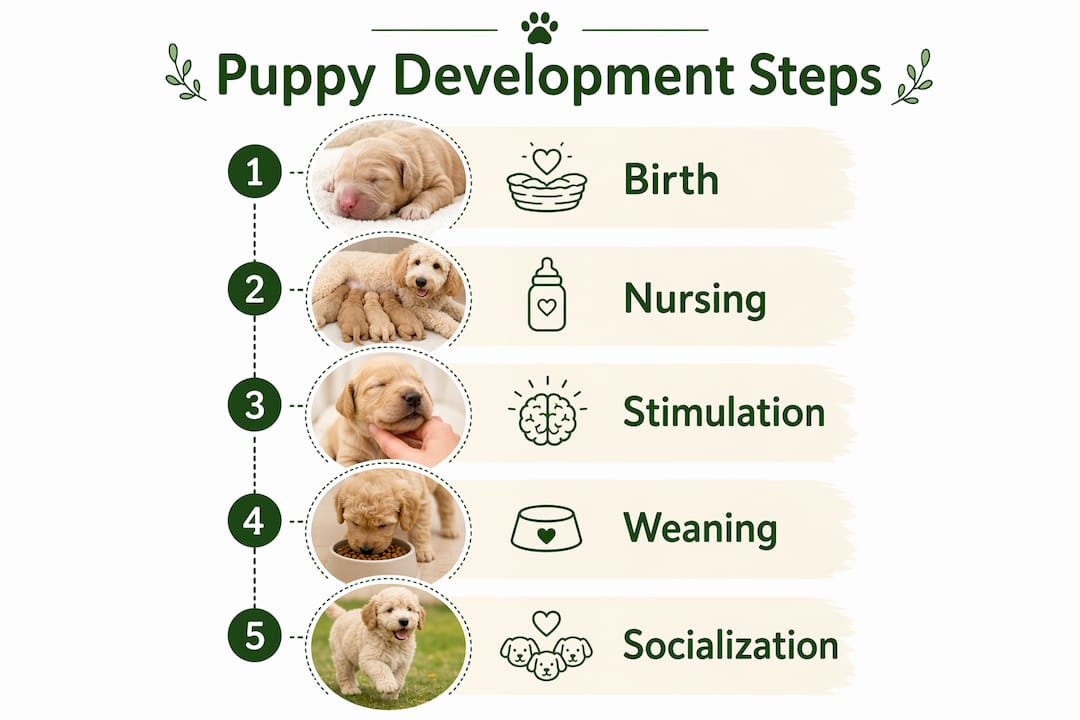
The transition to independence begins around weeks 3–4, when puppies start showing interest in solid food and the dam gradually reduces nursing frequency. This is not just a diet change. It is a behavioral shift: the mother begins leaving the whelping box for longer stretches, which pushes puppies to explore, play with littermates, and build confidence without her constant presence.
A typical weaning and separation timeline:
- Weeks 3–4: First interest in solid food; dam still nurses frequently but begins reducing contact time.
- Weeks 4–5: Puppies increasingly ambulatory; play with littermates intensifies; dam introduces social corrections (growls, muzzle nudges).
- Weeks 5–7: Solid food consumption increases; nursing becomes supplemental rather than primary.
- Weeks 7–10: Most puppies are fully weaned; bite inhibition and basic social responses are established.
- Weeks 8–12: The standard placement window. Eight weeks is the widely recommended U.S. minimum; small or fragile breeds often benefit from staying until 10–12 weeks.
Cornell University’s College of Veterinary Medicine recommends 8 weeks as the minimum age for separation, noting that by this point puppies are typically weaned, have absorbed core social lessons, and are emotionally more stable. Puppies separated at 4–6 weeks show measurably higher rates of fearfulness, aggression, and poor bite inhibition later in life.
Several U.S. states have enacted laws prohibiting the sale of puppies younger than 8 weeks. Requirements vary by state, so check your state’s specific animal welfare statutes before placing or purchasing a puppy.
How does the mother dog teach bite inhibition and social skills?
The dam is the puppy’s first teacher, and her lessons are not abstract. They are physical, immediate, and repeated dozens of times a day.
Bite inhibition develops through a specific feedback loop: a puppy bites too hard during play or nursing, the dam responds with a low growl or a firm muzzle grab, and the puppy learns to modulate pressure. This correction is not punishment in any punitive sense. It is communication, and it is far more effective than anything a human can replicate after the fact.
The socialization sensitive period spans roughly 3–16 weeks, and the dam’s behavior during the early part of that window sets the baseline. A calm, confident dam who approaches new people without alarm teaches her puppies, through direct observation, that humans are not a threat. A fearful or reactive dam does the opposite.
Research on maternal care and behavioral development found that the amount of maternal care received during the first 21 days was systematically associated with how puppies responded to unfamiliar people and environments at two months of age. More maternal care correlated with greater interest in strangers and more pronounced separation-related stress, suggesting that high-contact dams produce puppies who are socially engaged but also more dependent on proximity to attachment figures.
What puppies learn specifically from the dam:
- Appropriate play intensity and when to back off
- How to read and respond to canine body language
- Basic elimination routines (location, timing)
- Vocalization norms: when to call out and when to stay quiet
- Initial responses to human approach, touch, and handling
Maternal style is consistent per female and has measurable long-term effects on offspring temperament. This is why selecting dams with reliable, calm maternal behavior is one of the most practical things a breeder can do for adult dog outcomes.
What are the warning signs of maternal problems?
Most dams manage their litters without incident. When problems do arise, they tend to fall into two categories: medical and behavioral.
Medical red flags in the dam:
- Mastitis: hard, hot, or discolored mammary glands, often accompanied by fever and reluctance to nurse
- Systemic illness: lethargy, loss of appetite, or discharge after whelping that persists beyond 24 hours
- Insufficient milk: puppies nursing constantly but losing weight, crying persistently, or showing sunken flanks
Behavioral red flags:
- Complete rejection of one or more puppies (pushing them away, refusing to lie with the litter)
- Aggression toward handlers that prevents safe access to the puppies
- Failure to stimulate elimination in neonates
If the dam cannot or will not stimulate elimination, manual stimulation using a warm, damp cloth on the anogenital area must be performed after every feeding, around the clock. Missing even a few sessions can cause urinary retention or constipation in neonates.
When any of these signs appear, the first call is to your veterinarian. Mastitis requires prompt antibiotic treatment; a dam with systemic illness may need IV fluids and diagnostics before she can safely nurse. If the dam is temporarily unable to care for the litter, a foster dam or commercial puppy milk replacer (never cow’s milk) bridges the gap. Hand-raising an entire litter is a 24/7 commitment for the first three weeks, with feedings every 2–3 hours and manual elimination stimulation at every feed.
How can you support the dam and help puppies develop well?
The dam does most of the work. Your job is to make sure she has everything she needs to do it.
Nutrition during lactation is the single highest-leverage intervention available to you. A nursing dam’s caloric needs can be two to four times her normal maintenance requirement, depending on litter size. High-quality, calorie-dense food and constant access to fresh water are non-negotiable. Dam health directly shapes puppy outcomes, from milk quality to the energy she has for grooming and stimulation.
Pro Tip: Transition the dam to a puppy or performance formula during the last trimester and through weaning. The higher protein and fat content supports both milk production and her own body condition.
Early human handling should be brief, calm, and guided by the dam’s tolerance. Dr. Hohenhaus recommends supervised contact from the first days, as the dam allows. Short, gentle handling sessions build positive human associations without disrupting the maternal bond. Avoid loud visitors, unfamiliar dogs, or chaotic environments near the whelping box in the first two weeks.
| Support Area | Recommended Practice | Timing |
|---|---|---|
| Dam nutrition | High-calorie, high-protein diet; unlimited water | Last trimester through weaning |
| Whelping environment | Quiet, warm (85–90°F for neonates), draft-free | Weeks 0–3 |
| Human handling | Brief, calm contact as dam allows | Days 3–7 onward |
| Socialization exposures | Controlled, gradual: sounds, surfaces, people | Weeks 3–16 |
| Puppy weight checks | Daily in week 1; every 2–3 days through week 4 | Weeks 0–4 |
Breeder monitoring checklist: what Lakewoodranchdoodles tracks daily
Objective daily logs catch problems before they become emergencies. A single observation tells you almost nothing; a trend over three days tells you everything.
Daily monitoring checklist:
- Dam behavior: Is she nursing willingly, grooming the litter, and resting in the box? Any reluctance or aggression?
- Nursing frequency: Are all puppies getting regular access to nipples? Are any being consistently displaced?
- Puppy weights: Weigh each puppy at the same time each day. Healthy puppies gain weight steadily after day 2.
- Elimination: Are puppies urinating and defecating after each feeding? Color and consistency matter.
- Temperature: Whelping box ambient temperature should be 85–90°F in week 1, stepping down to 75–80°F by week 4.
- Litter cohesion: Are puppies piling together for warmth? Isolated puppies that cannot self-regulate are at risk.
Intervention thresholds:
| Observation | Threshold for Action | Next Step |
|---|---|---|
| Puppy weight | No gain by day 3, or any loss after day 2 | Supplement feeding; contact vet |
| Nursing refusal by dam | Consistent across two or more feedings | Assess for mastitis; contact vet |
| Failure to eliminate | Missing after two consecutive feedings | Manual stimulation; contact vet if no result |
| Dam temperature | Above 102.5°F or below 99°F post-whelp | Veterinary evaluation same day |
| Puppy crying | Persistent, high-pitched crying | Check weight, warmth, and nursing access |
Nursing posture matters too. Research suggests that dams who nurse lying down versus sitting or standing affect how much effort puppies expend to access milk, and this difference has been linked to differential outcomes in working dog programs. Log nursing posture as part of your daily record.
Pro Tip: Use a simple spreadsheet or a notebook with one row per puppy per day. Weight, nursing time, elimination count, and any notable dam behavior. Quantitative logs are the most reliable early-warning system you have, far more useful than memory or general impressions.
Key Takeaways
The mother dog’s role in puppy development is irreplaceable in the first eight weeks, with colostrum timing, elimination stimulation, and maternal social modeling each carrying consequences that extend into adult behavior.
| Point | Details |
|---|---|
| Colostrum window is critical | Antibody transfer happens in the first 24–48 hours; missed colostrum raises infection risk significantly. |
| Neonatal dependence lasts 3 weeks | Puppies cannot thermoregulate or eliminate without the dam until approximately week 3. |
| 8 weeks is the U.S. minimum | Separation before 8 weeks is linked to fearfulness, aggression, and poor bite inhibition in adult dogs. |
| Maternal style shapes temperament | A calm, consistent dam produces puppies with more stable social responses; dam selection matters. |
| Daily weight logs catch problems early | Objective daily records are the most reliable early-warning tool for both puppy and dam health. |
What breeders know about maternal styles that most guides skip
The research confirms what experienced breeders already know: not all dams mother the same way, and those differences are not random. Maternal style is consistent per female and is shaped by genetics, litter size, parity, and stress levels. A first-time dam often shows more anxiety and inconsistency than a seasoned one. That is normal. What is not normal, and what warrants intervention, is a dam who consistently ignores or rejects her litter across multiple sessions.
At Lakewoodranchdoodles, selecting dams with reliable maternal behavior is part of the breeding program from the start. A dam who is calm, attentive, and tolerant of brief human handling in the first days makes early socialization far easier and produces puppies who arrive at their new homes already comfortable with people. That is not an accident. It is the result of watching maternal behavior across litters and making deliberate choices about which females to breed again.
The honest trade-off breeders face is time versus placement. Keeping a litter to 10 or 12 weeks means more labor, more food, and a longer wait for families. But for smaller or more sensitive breeds, those extra weeks with the dam and littermates often produce a noticeably more confident puppy. Socialization windows and later training matter enormously, but they build on a foundation the dam laid in the first eight weeks. You cannot fully compensate for what was missed in that window, no matter how good the training that follows.
Primary sources and further reading
- Maternal behaviour in domestic dogs (PubMed) — Peer-reviewed review covering nursing, grooming, licking, and the hormonal basis of maternal care; the most comprehensive literature synthesis available.
- A review of maternal behaviour in dogs (PubMed) — Examines how maternal style is measured, what influences it, and its long-term effects on puppy behavior; useful for breeders evaluating dam selection.
- Influence of maternal care on behavioral development (PMC) — Study of 72 family-reared puppies linking early maternal care to social responses at two months; the clearest evidence for why the first 21 days matter.
- Cornell University College of Veterinary Medicine: puppy separation timing — Authoritative veterinary guidance on the 8-week minimum, socialization windows, and risks of early separation.
- AKC: canine mother and puppy separation — Accessible overview with veterinarian commentary on neonatal dependence, weaning, and early human handling.
- Levels of maternal care and adult temperament (Scientific Reports) — German Shepherd study demonstrating that consistent maternal care correlates with measurable differences in adult social behavior and aggression.
- Roadmap for maternal behavior research in dogs (Frontiers in Veterinary Science) — Covers natural maternal strategies including extended provisioning and nursing posture effects; good for understanding the full range of normal maternal behavior.
- Neonatal puppy physiology and maternal care (PMC) — Peer-reviewed review on altricial birth, thermoregulation, and why colostrum timing is non-negotiable.
- Transition to independence and weaning dynamics (PMC) — Examines the behavioral shift around weeks 3–4 when the dam reduces contact to encourage exploration.